
Let’s get something straight.
In live music, your biography is not a poetic diary entry. It’s not therapy. It’s not a vague mood board wrapped in adjectives.
It’s a positioning document.
Venue managers skim it. Festival curators scan it. Media copy from it. Agents paste it into proposals. If it’s weak, confusing, bloated or self-indulgent — you lose seconds. And seconds lose gigs.
I think I’ve read close to a million bios over the years. Too many times, a local journalist could have written a last minute story on an artist but passed thanks to the bio. The difference between booked and bypassed is often just one thing: clarity.
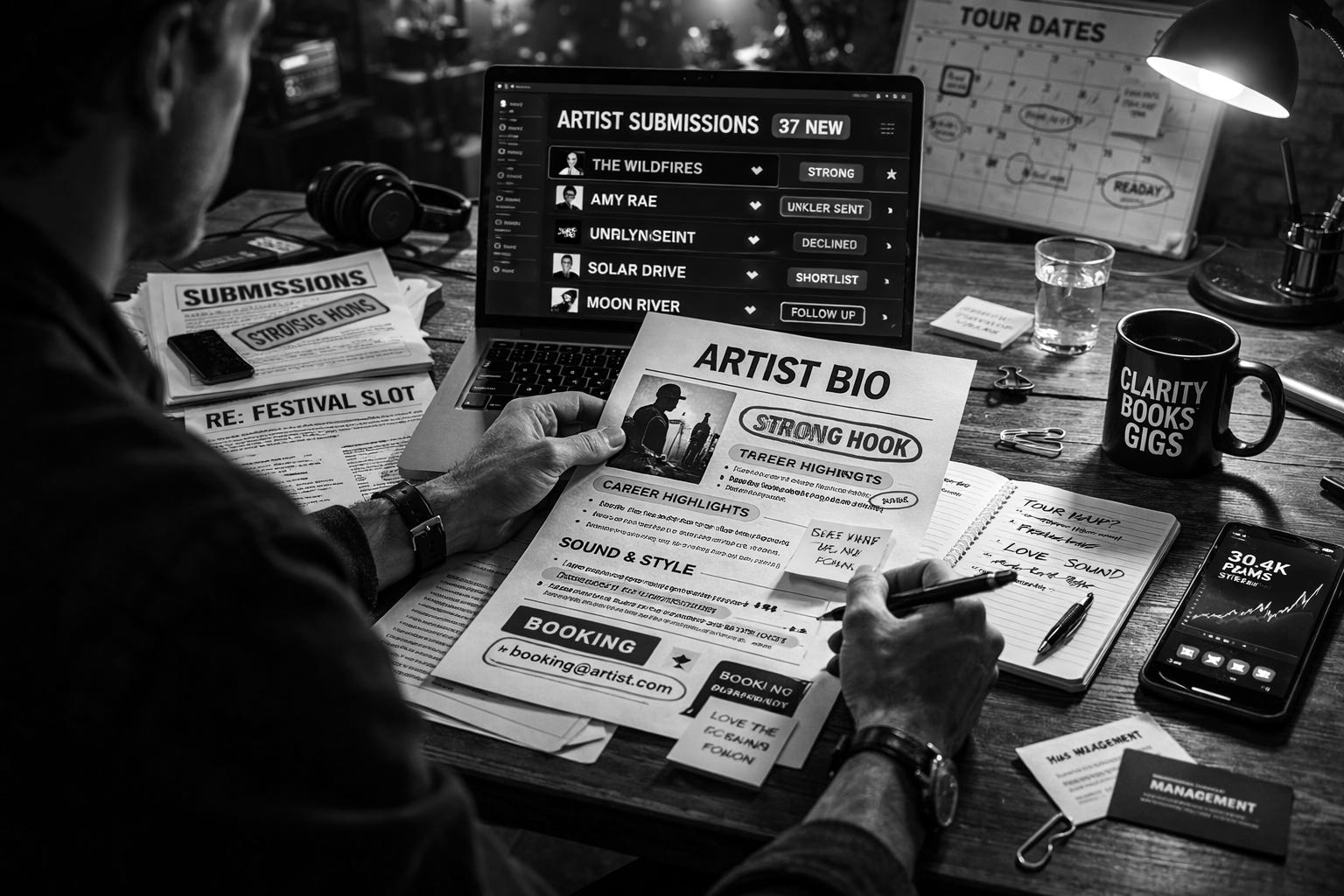
Here’s how to write a biography that actually works.
1. Engaging Introduction
Hook first. Explain second.
Your opening lines must do three things immediately:
Establish your musical identity
Signal your market position
Create intrigue
No clichés. No “has loved music since childhood.” Everyone has. Instead, ask yourself: Why should the reader care in the first 10 seconds?
Example structure:
A bold descriptor
A defining sound
A signal of credibility
This isn’t ego. It’s orientation. You’re telling the industry where to file you in their brain.
2. Your Story (But Make It Strategic)
Your background matters — but only the parts that build value.
Keep it:
Concise
Positive
Relevant to your trajectory
Your story should reinforce:
Work ethic
Professional growth
Market experience
Cultural context
This is not the place to unpack struggle unless it strengthens your brand narrative.
Think of it as origin positioning. Not autobiography.
3. Description of Your Music
Be specific. Always.
“Eclectic.” “Unique.” “Genre-blending.”
These words say nothing. Instead:
What genre lanes do you operate in?
What does your audience feel?
Who are your sonic reference points?
What size room does your sound suit?
For example:
Pub rock energy with festival-ready choruses
Soul-pop vocals layered over electronic production
Acoustic storytelling built for intimate theatres
Specificity creates bookability.
4. Career Highlights and Achievements
Integrate. Don’t list.
This is where most bios go wrong.
Instead of bullet-point bragging, weave your achievements into your narrative:
Tours
Festival appearances
Charting releases
Sync placements
Support slots
Awards
Significant streaming milestones
Remember: Context matters more than numbers. A support slot for a major touring act tells a booker more than “10,000 monthly listeners.” Milestones signal market validation. That’s what decision-makers look for.
5. Upcoming Projects and Current Momentum
Show movement.
Nothing kills confidence like a stale bio. Always include:
Recent releases
Current tour dates
New collaborations
Upcoming projects
Development milestones
The industry backs momentum. If you’re building, say it. If you’re evolving, explain how. If you’ve refined your show, define it.
Static artists look risky. Moving artists look investable.
6. Media Quotes
Borrow credibility.
Well-placed testimonials accelerate trust. Include:
Reviewer quotes
Radio endorsements
Industry praise
Promoter feedback
Keep them:
Short
Powerful
Specific
Not “great act.” But “commands a crowd with rare authority.”
Third-party validation compresses doubt.
7. Contact Information & Social Links
Remove all stumbling blocks.
You would be amazed how many bios forget this. Every brand kit should include:
Booking contact
Management contact
Email
Phone (if applicable)
Website
Streaming links
Social handles
Make it effortless to engage. If someone has to hunt for how to book you, they won’t.
8. Closing Statement
Echo your introduction. Reinforce your identity.
Circle back to your positioning. Your final line should:
Reaffirm your sound
Reassert your purpose
Signal your future
This creates narrative cohesion. It leaves the reader with clarity. And clarity books gigs.
Why a Killer Biography Is Vital in Your Brand Kit
Your biography feeds:
Press releases
Website copy
Booking pitches
Festival submissions
Streaming profiles
Sponsorship decks
Grant applications
Venue programs
Media interviews
It is the master document in your Pitch Deck.
When I work with an artist, I build systems around brand intelligence. The biography is a core data source in that system. If it’s confused, everything downstream is diluted.
Your bio is not decoration. It’s infrastructure.
The Hard Truth
Most musicians under invest in writing. They obsess over the mix, the master, the photos — and then rush the words. But in live entertainment, the written narrative often gets read before the first note is heard. If your bio doesn’t communicate:
Market fit
Professionalism
Momentum
Clarity
You’re invisible in a crowded room. And invisibility is expensive.
Final Word
Write your biography like a strategist. Edit it like a publicist. Position it like a brand architect.
Because in this industry, your story isn’t just who you are.
It’s how you get booked.
Written by Nichola Burton. I work in partnership with Agents, Artist Managers and Event Producers, who juggle a diverse range of relationships in the Musoverse, to curate, manage and measure data in systems, experience, creative and content to support the entire Musoverse operation in my enterprise A Little Pitchy Copyright 2026