

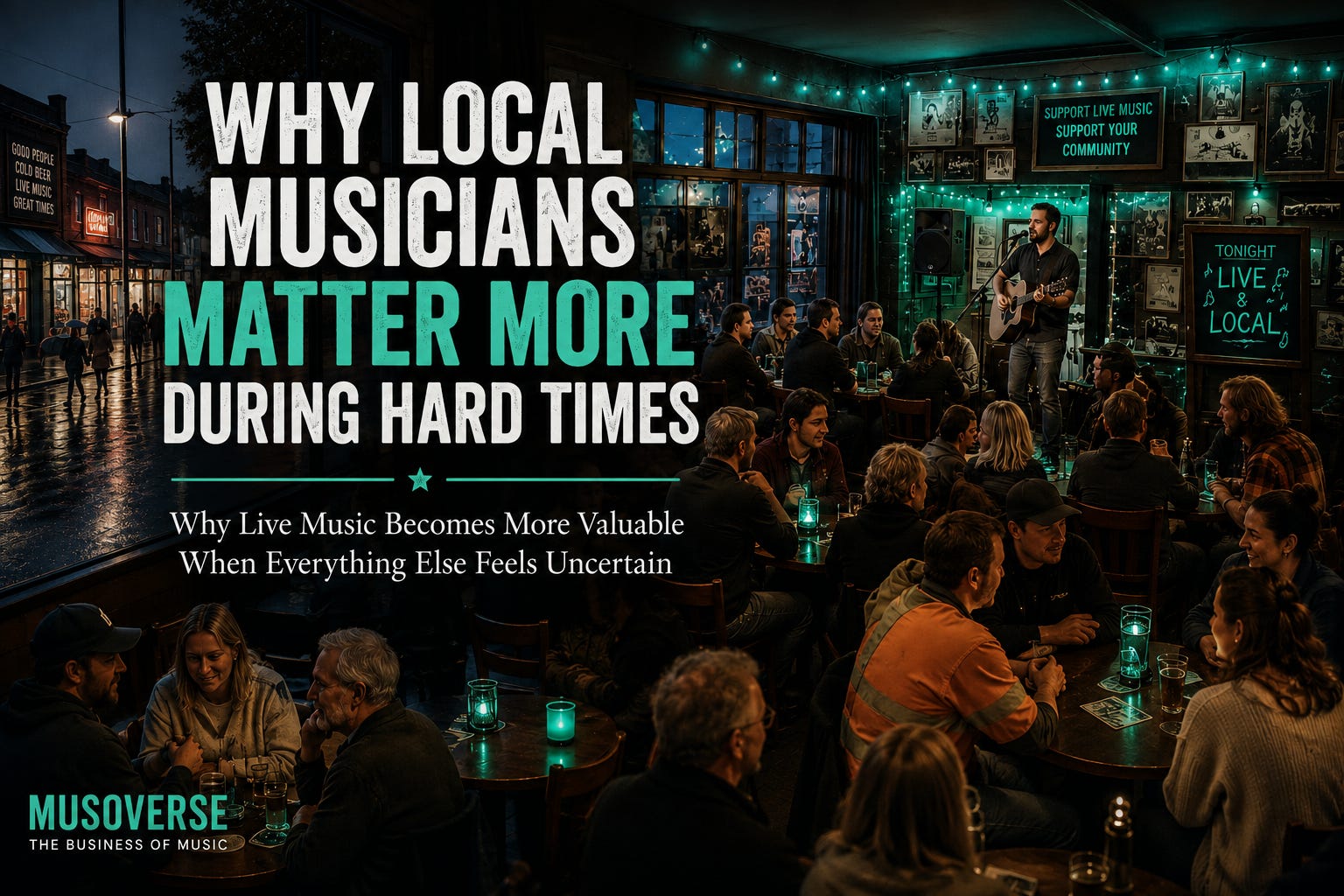
The pub stage has always been more than a stage. When economic clouds gather, something curious happens. People stop buying luxuries. They postpone holidays. They think twice about major purchases.
Yet somehow, every Friday night, someone still walks through the doors of their local pub, orders a drink, finds a familiar face, and settles in to hear a musician play songs they know by heart.
For generations, local pubs and clubs have been Australia’s unofficial town squares. They are where communities gather, stories are exchanged, birthdays are celebrated, heartbreaks are forgotten, and victories are toasted.
And at the centre of it all is live music.
Never underestimate the value of a song during uncertain times. In 2026, musicians face enormous challenges. Cost-of-living pressures continue to affect audiences. Venues are balancing rising wages, insurance premiums, energy costs, food costs and increasing competition for every discretionary dollar. Musicians themselves are navigating higher fuel costs, equipment expenses, marketing demands and the reality that simply being a great performer is no longer enough.
Yet history tells us something remarkable.
When times become difficult, people often turn towards music, not away from it.
Research examining music consumption during periods of economic uncertainty found that people actively seek out more positive music experiences as a way of balancing stress, anxiety and social pressures. Music becomes a tool for emotional regulation and wellbeing when the outside world feels uncertain.
A recent review of more than 17,000 participants across multiple live music studies found that attending live music events consistently creates opportunities for connection, belonging, shared identity and community support. The benefits were found across genres, demographics and event sizes.
That matters.
Because loneliness, isolation and financial stress often travel together. A live music venue may not solve those problems, but for a few hours it can remind people they are not facing them alone.
There is another statistic worth considering. Goldman Sachs research found that over the past 30 years, the live music industry grew by an average of 7.3% during recession years, outperforming many other entertainment sectors.
Even more telling, only 6% of consumers surveyed said live music would be the first thing they would cut from their spending if finances became tighter.
Think about that. People will sacrifice many things before they sacrifice experiences that make them feel alive. That is because live music is not simply entertainment. It is human connection. It is belonging. It is collective memory. It is a room full of strangers singing the same chorus at the same moment and remembering that they are part of something larger than themselves.
And bottom line, live local music is the most resilient form of entertainment.
The local musician of 2026 is no longer just a musician.
They are:
A performer.
A storyteller.
A content creator.
A community builder.
A brand ambassador.
A small business owner.
The musicians who thrive will understand that every performance extends beyond the stage. The audience no longer discovers artists solely through posters and venue advertising. They discover them through conversations, videos, social media clips, newsletters, community groups and personal recommendations. Musicians who build relationships will outperform musicians who only build setlists.
Smart venue operators understand something many accountants cannot measure. The value of live music is not found in the ticket price. It is found in the atmosphere. The return customer. The extra hour a patron stays. The friendships formed. The community culture built over years rather than weekends.
A musician who understands a venue’s audience, demographic and business objectives becomes more than an entertainer. They become a partner in building culture. And culture is what transforms a venue from somewhere people visit into somewhere people belong.
None of this means the road is easy. Musicians have always lived with uncertainty. The late Tom Petty understood that reality when he said: “You belong among the wildflowers. You belong somewhere you feel free.”
For many musicians, the stage is exactly that place. Not because it is easy. Not because it is lucrative. But because something inside refuses to stop creating. Refuses to stop connecting. Refuses to stop turning life’s chaos into songs.
The future belongs to musicians who understand one simple truth. The real job is not merely to perform music. Your job is to create moments that people carry home with them. In difficult times, those moments become even more valuable. The local pub stage may seem small. But for someone walking through the door carrying the weight of the world, it can feel like the centre of it.
And that is why local musicians still matter. Perhaps now more than ever.
Written by Nichola Burton. I work in partnership with Agents, Artist Managers and Event Producers, who juggle a diverse range of relationships in the Musoverse, to curate, manage and measure data in systems, experience, creative and content to support the entire Musoverse operation in my enterprise A Little Pitchy Copyright 2026
