
What Exactly Is a Venue Buying?
The superannuation debate has exposed a much bigger question: when a venue books live entertainment, is it paying for labour, or purchasing the output of an independent entertainment business?

Somewhere along the way, Australia’s live music industry has started talking as though every performance is the same. It isn’t.
A solo performer walking into a venue with an acoustic guitar may be one commercial arrangement. A fully produced tribute show arriving with trucks, production crews, lighting, costumes, rehearsals, marketing campaigns and a recognised entertainment brand is another. Yet much of the current conversation treats them as identical.
They are not.
One phrase keeps appearing in this debate: Results-Based Contract. But what does that actually mean? A results-based contract is not simply an agreement to turn up. It is an agreement to deliver an agreed commercial outcome.
In hospitality, venues rarely purchase labour. They purchase results. A packed room. An engaged audience. Longer patron dwell time. Food and beverage sales. Venue reputation. Customer experience.
Those outcomes are why live entertainment is booked. The performance is simply the mechanism that delivers them.
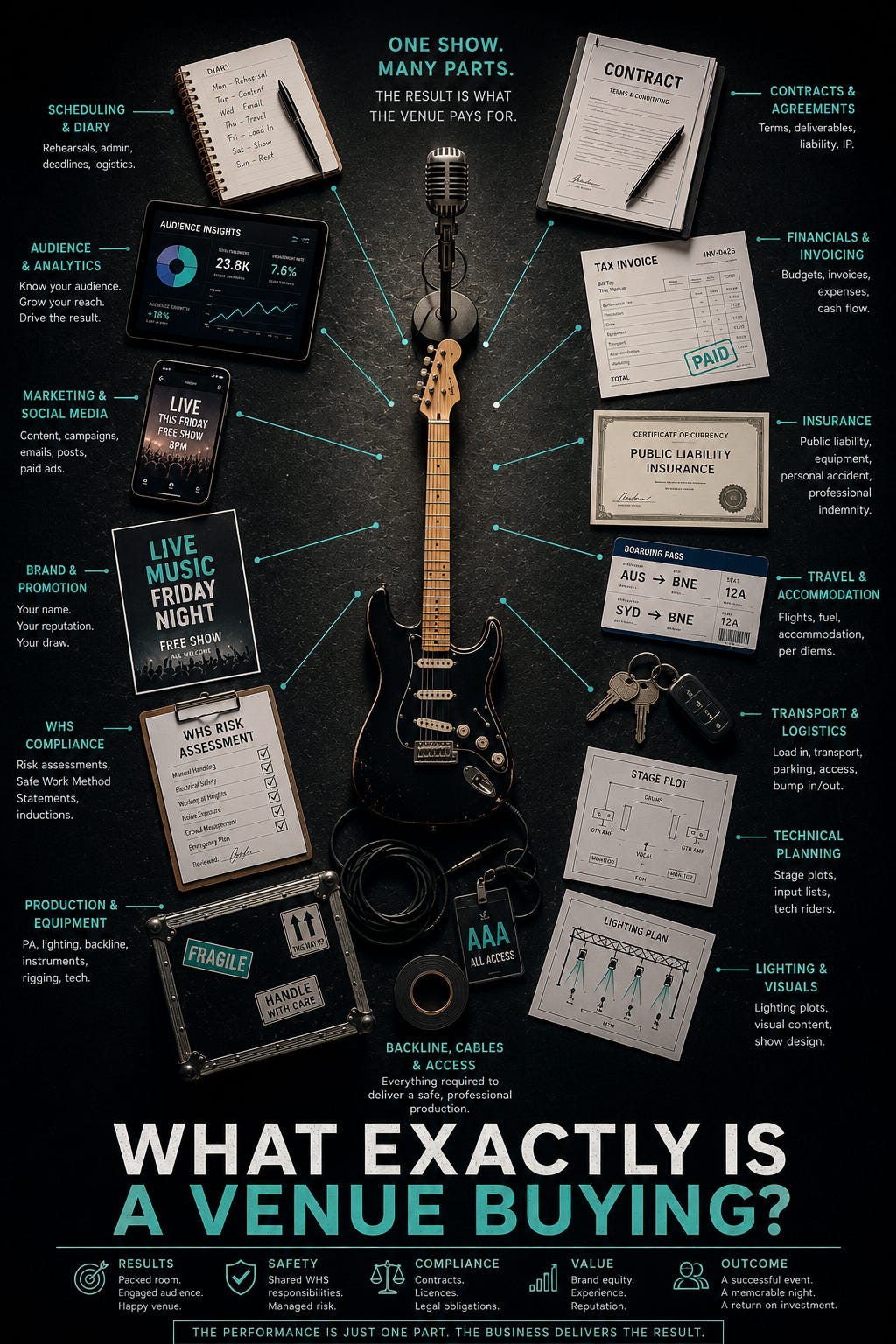
Let’s take a guaranteed performance at a hotel where the public pays no entry fee. Many people assume the venue is paying a musician simply to perform. But look more closely. The venue is often purchasing the delivery of an entire entertainment project. That project commonly includes a fully produced and delivered show where the artist may supply Production equipment, Audio systems, Lighting, Backline, Stage infrastructure, Technical planning, Crew coordination and Bump in and bump out.
The commercial outcome is not “play music.” The outcome is the delivery of a fully produced show whose ROI can be measured in a variety of ways.
The venue is in essence buying access to the artist’s audience and reputation. That may include Social media promotion, Email marketing, Content creation, Brand recognition, Audience mobilisation and Community engagement. The artist’s brand has commercial value. It is one of the reasons the venue books that particular act rather than another.
In Queensland, both the venue and the artist are jointly liable under the Work Health and Safety Act 2011 (Qld). Where more than one Person Conducting a Business or Undertaking (PCBU) has duties relating to the same matter, the Act requires them to consult, cooperate and coordinate activities. For fully produced shows, artists commonly manage production risks associated with equipment, staging, crew and logistics as part of delivering the contracted entertainment outcome.
The commercial relationship between the venue and the entertainment business is also subject to the Australian Consumer Law. The contracted entertainment services must generally be provided with due care and skill and substantially match what was promised. Again... That is an outcome. Not simply attendance.
Now comes the question of Superannuation. Subsection 12(8) of the Superannuation Guarantee legislation requires each payment to be examined on its own facts. The Commissioner’s ruling says the substance of the arrangement is more important than the label attached to it. It also says that a payment, or part of a payment, must be directly referable to the individual’s performance.
That raises an important practical question. If an entertainment business delivers a fully produced and delivered show, production, equipment, IP, marketing, administration, insurance, transport, accomodation and event management, which part of the payment is referable to the performance itself?
The ruling identifies the question. It does not prescribe a universal formula for answering it.
While every business obtains their own advice, these questions should be paramount. How should bundled entertainment services be analysed? When is a venue purchasing labour, and when is it purchasing a fully produced entertainment outcome? How should production, equipment and intellectual property be treated? How should established entertainment brands be valued? Is there an accepted methodology for identifying any component of a bundled fee that is directly referable to performance?
These are practical questions faced every day by venues, promoters, accountants and entertainment businesses.
The current debate is often framed as though every musician is simply a sole trader supplying labour. That assumption does not reflect the diversity of Australia’s live entertainment industry. Many professional acts operate sophisticated entertainment businesses that create, market, produce and deliver complete entertainment products involving production, logistics, branding, compliance and audience development—not simply live performance.
Whether a particular engagement attracts Superannuation Guarantee obligations depends on the specific facts of that engagement. What seems clear, however, is that not every live entertainment engagement is commercially identical. Until there is greater certainty around how bundled entertainment services should be analysed, broad statements such as “every musician now gets super” or “results-based contracts solve the issue” are unlikely to capture the full picture.
Perhaps the better question is not: “Is this musician a sole trader?” The better question is: “What exactly has the venue contracted this entertainment business to deliver?”
Because once you answer that honestly, you’ve started examining the substance of the arrangement—the very place the legislation tells us to begin.
Written by Nichola Burton who has spent more than three decades building the systems behind Australia’s live entertainment industry. As the co-founder and CEO of The Pushworth Group, she works at the intersection of music, business, law, technology and hospitality. Through Hacking the Musoverse, she explores the questions hiding beneath accepted industry thinking—challenging assumptions, connecting the dots, and translating complexity into practical insight for the people who keep live music alive. Copyright 2026
