

I recently started down a rabbit hole reading the history of APRA, and before I knew it, I was knee-deep in memories, conspiracy theories and more questions than answers. Because for me, I am endlessly fascinated by how music is so intricately woven into the history and culture of the Australia I grew up in. And, as usual, it starts with a family story.
Betty (my mother-in-law) played piano for Palings in Brisbane City in the 1940s. Her job was to sit at the keys in the store and play the latest songs from the sheet music arriving on the shelves. Someone would hear a song they recognised. Someone else would stop to listen. A customer might imagine how wonderful that piano would sound in their own living room. Before long, somebody was reaching for their purse.
Live music has always made people feel good. Back then, it made them curious. It encouraged them to linger. It created an atmosphere that transformed an ordinary retail transaction into an experience. And experiences sell products.
Meanwhile, fifty years earlier, in Port Macquarie, another young girl was seated at a piano. Eva (my great-grandmother) grew up in her mum’s pubs on the central New South Wales coast. A gifted musician, Eva had perfect pitch, an extraordinary musical memory and the ability to reproduce songs after hearing them played just once. My grandmother shared with me how Eva loved hanging out in the temporary showrooms in pubs around Port Mac that were set up by Palings for pianists to demo the latest sheet music and instruments. (Like Betty did fifty years later)
Eva listened. Remembered. Then went home, sat at the piano and played note for note what she’d heard. Eva didn’t just play piano. She recruited musicians, put them together into bands and organised them to perform in the family pubs. And when the bands played, the customers came. People gathered. Danced. Socialised. Bought drinks and stayed longer. The pub always did better business when Eva and her bands performed. She instinctively understood the relationship between live entertainment and increased turnover. She wasn’t merely entertaining customers. She was helping build the family business and was doing it with musical skills that many professionally trained musicians would envy.
Because while women like Eva and Betty were living examples of the commercial power of music, another group of people were plotting a new way to make money from it.
Up until 1800, one piano existed in the colony. In 1888, French music writer Oscar Comettant calculated that about 700,000 pianos had entered or been built in Australia, a figure supported by modern cultural historians like Michael Atherton in A Coveted Possession: The Rise and Fall of the Piano in Australia. So by the early twentieth century, a thriving music retail and publishing industry had emerged.
Music wasn’t an optional little luxury. It was woven into everyday Aussie life. People sang at home, gathered around pianos, attended dances, joined bands, played in churches and filled theatres and pubs. A piano was a pretty huge household purchase. And sheet music was the vehicle for families to bring the latest popular songs into their homes. Music retailers weren’t simply selling products. They were selling participation in a cultural experience.
Businesses such as Allans, Palings, Nicholsons and J. Albert & Son had built substantial commercial operations around that demand. They sold instruments. Published music. Arranged distribution. Developed relationships with overseas publishers. Acquired and administered copyrights. Some employed musicians to showcase their pianos. Just like Betty did a couple of decades later. Others sent reps into regional Australia to find customers who couldn’t visit a capital-city music emporium where kids like Eva could pick up the latest hit.
Australia was a burgeoning economy trying to find its feet. Before any sort of technology, it was music that connected its people. And that music was fast becoming a valuable commercial asset. And it is at this point that official public radio broadcasting in Australia began on 23 November 1923 at exactly 8:00 pm, when Sydney station 2SB went on the air in this once convict colonised backwater.
Imagine you’re a successful music publisher in the 1920s. For decades, you’ve made money selling printed music and instruments to people who want to enjoy their favourite songs. Then this new technology arrives. Radio. And suddenly, people can hear music without buying the sheet music, attending a performance or purchasing an instrument. A single broadcast can reach thousands of listeners.
For music lovers, this is fantastic. For established music publishers, it creates panic. But because, although listeners no longer need to purchase a printed copy to hear a song, the copyright in the composition still exists; therefore, copyright law provided rights holders with legal control over certain uses of that music, including public performance. And so the panic upgraded into opportunity.
Australia’s Copyright Act 1912 had already established the legal framework for protecting those rights. The publishers didn’t need to invent copyright. They needed to work out how to enforce and monetise it in a rapidly changing market. And pursuing every broadcaster, dance hall and hotel individually wasn’t exactly an efficient way to run a business. So they did something rather unexpected and got together to form a collective.
As history demonstrates, on 11 January 1926, six music publishers gathered for the first board meeting of the Australasian Performing Right Association. The businesses identified in APRA’s founding history were: Allans. Chappell & Co. E.W. Cole. J. Albert & Son. Nicholsons. Palings. APRA’s original Memorandum of Association, dated 23 December 1925, actually records nine signatories. Alongside those six were L.F. Collin, D. Davis & Company and Sam Fox Publishing.
So while the story of six publishers at the first board meeting is part of APRA’s centenary history, the original constitutional documents reveal a wider group involved in establishing the organisation formally incorporated on 4 January 1926 as a company limited by guarantee.
And it is important to remember that APRA was not a government department. Not a statutory authority created to administer Australian music. It was a private organisation. Established by music publishing interests with a very clear purpose to stay in business. (Oh, and administer and license performing rights collectively.)
The publishers already held or administered valuable rights in musical compositions. APRA’s structure enabled performing rights to be acquired through assignments or other arrangements and licensed through a central organisation. Instead of a radio station negotiating separately with numerous publishers, it could obtain a licence covering a substantial repertoire. Instead of individual rights holders chasing businesses for payment, APRA could collect licence fees and distribute royalties under its rules.
From an administrative perspective, there were obvious advantages. But from a commercial perspective?
Well.
Businesses that might otherwise have negotiated independently now had a collective licensing organisation representing their rights. And you can’t have a radio station without music. Right? As an emerging industry, music was one of radio’s greatest attractions. People wanted to hear songs. Broadcasters wanted listeners. Advertisers wanted audiences. Sound familiar? E. W. Cole (APRA founder) hiring a live orchestra and brass band at Cole’s Book Arcade Collection drawing massive crowds and creating a festive atmosphere. Jacques Albert, (another APRA founder) playing the violin to entertain customers in his small watch repair shop. Eva, playing piano in her mum’s pub. Betty, playing piano in the Brisbane city Palings store.
Each one of them knew that music attracts people and people attract money.
So now, in Australia, in 1926, there was one new business in the middle of the music, the people and the money.
APRA’s collective licensing model meant broadcasters could obtain access to represented repertoire through a central licence. It also meant the organisation possessed considerable bargaining power. And boys, were those broadcasters pissed about the terms! So much so that only a few years after APRA’s establishment, the relationship between the collective licensing organisation and Australia’s broadcasters had become so toxic that it had become a matter for a well documented Royal Commission on Performing Rights in 1932–33.
Astonishingly, at this time in history, music was already an international business. Quite remarkable when you consider the distinct lack of technology for these businesses to stay connected. APRA developed reciprocal arrangements with international performing-rights organisations, enabling it to represent overseas repertoire in Australia while Australian repertoire could be represented abroad. British and American songs travelled through publishing agreements, sheet music distribution and eventually broadcasting.
APRA didn’t own every song in the world. It had become the licensing authority over an increasingly extensive repertoire. Once an organisation represents a substantial proportion of the music people want to hear, the question for music users is no longer simply whether they like the licensing arrangement.
It’s whether they have a viable alternative.
It’s important to remember that APRA was established by publishing interests. Not by a gathering of independent songwriters sitting around somebody’s kitchen table, wondering how to collect their radio royalties. Publishers had long acquired or administered copyright through commercial agreements with composers. Some songwriters received royalties under those agreements. Others may have assigned particular rights for fixed payments or on terms that proved less favourable as new technologies emerged. The precise arrangements varied. But the commercial relationship between the person who created the composition and the business controlling its publishing rights was not necessarily equal.
And the early APRA structure reflected the influence of publishers over the songwriters. Over subsequent decades, songwriters gained direct membership, representation and royalty distribution arrangements. APRA’s centenary history records writer membership beginning in the 1930s and direct payments to writers beginning in the 1940s. Today, APRA has a board comprising elected writer and publisher directors.
A hundred years after APRA was established, the underlying commercial relationship hasn’t changed that much. Music still brings people together. It still makes customers stay longer. It still fills pubs, clubs, restaurants, theatres and festivals. It still sells drinks, meals, tickets and experiences. I know because I’ve spent much of my working life in the music business. I’ve seen the difference between a room with music and a room without it. I’ve watched audiences walk through the door because a musician was playing. I’ve seen hospitality businesses build loyal customers around regular entertainment. And I’ve spent enough time dealing with the commercial and administrative machinery of this industry to appreciate that making music happen involves considerably more than simply plugging in an amplifier.
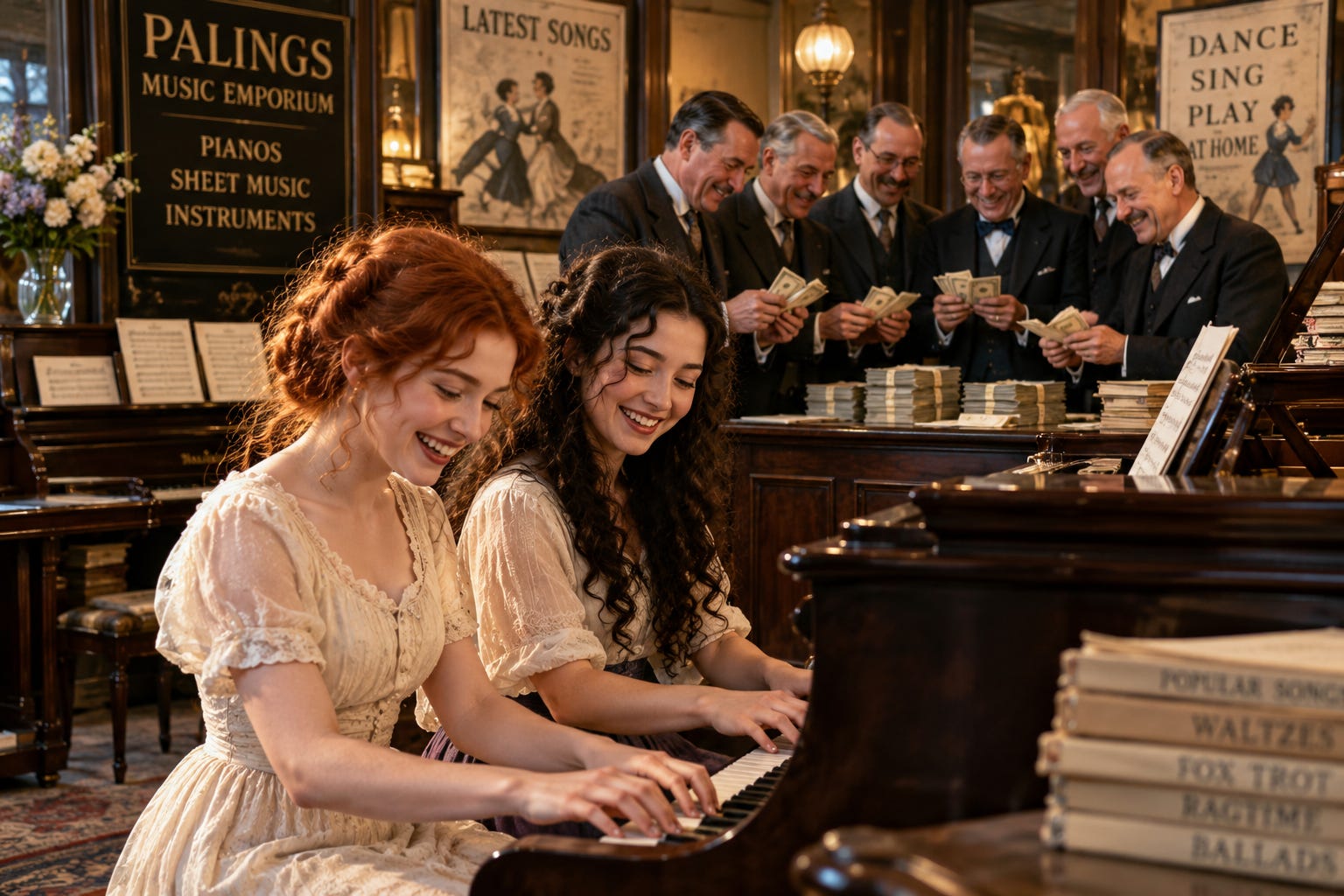
But when I think about the origins of this story, I don’t picture six businessmen sitting around a table.
I picture two girls at their pianos.
And somebody, somewhere, collecting another royalty.
Historical Sources and Further Reading
Australian music retail: Commerce and Culture: Music Emporia and Modernity in Late Nineteenth-Century Australia (2025).
Founding documents: APRA Constitution and Memorandum of Association.
Incorporation: APRA Certificate of Incorporation, 4 January 1926.
Organisational history: APRA: A Century of Song.
Royal Commission: Royal Commission on Performing Rights, 1932–33, Parliamentary Papers 1932–34, Vol. IV, pp. 1163–1220.
Competition oversight: ACCC — Re-authorisation of APRA’s collective administration arrangements, 2006.
Current dispute resolution: Copyright Tribunal of Australia.
Industry governance: Code of Conduct for Copyright Collecting Societies.
Story Source: The Women Played. The Men Got Paid.
Nichola Burton is co-founder and CEO of The Pushworth Group and the voice behind Musoverse and has spent more than 35 years in the Australian music business, building businesses, challenging conventions and discovering that the official version of history isn’t always the whole story. Copyright 2026
