

I have been reading the Queensland Nightlife Economy Action Plan 2026–2032. I want to be excited about it. I really do. There is a lot in there that makes sense. Queensland needs stronger touring circuits. We need more people going out at night. We need more live music. We need regional markets connected properly. And with the Olympics arriving in 2032, we have a fairly extraordinary opportunity to decide what we want Queensland to look, feel and sound like when the rest of the world gets here.
Then I read: “Strengthen the live music ecosystem through incentives for local artist exposure.” And I thought, here we go. Which local artists? Because if we are going to spend the next six years strengthening the live music ecosystem, can we please make sure we are talking about the whole ecosystem?
There is an enormous workforce sitting in plain sight that has been consistently overlooked in these conversations. I call them Soundtrackers. These are the soloists, duos, bands, DJs, tribute acts and working musicians who play in Queensland pubs, clubs, hotels, RSLs, resorts, breweries, festivals and regional venues every week. They play the songs people know.
But apparently, that makes them less interesting in some parts of the music industry. It certainly shouldn’t make them less important. Because these musicians do something incredibly valuable. They build audiences that Queensland on Tour will need to tap into.
Audiences don’t just magically materialise because somebody releases an original song. People develop habits. They know there is music at their local on Friday night, so they meet their friends there. Sunday afternoon there is a band in the beer garden. They stay for dinner. Have a drink. Hear a song. Follow an act. Come back next week. Do that often enough and you have a music culture. Soundtrackers do this week in and week out. They tune audiences to live music. And that audience is incredibly important to every other part of the music market.
Because where exactly do we think the audience for original music comes from? Where do we think people develop the habit of buying tickets, following bands and going out to see live entertainment? There seems to be an odd idea that soundtrack music and original music exist on opposite sides of some cultural fence. They don’t. The same musicians often work in both. The guitarist playing covers at a hotel on Friday may be recording an original project on Monday. And the money from Friday’s gig may very well be paying for Monday’s recording session.
That’s the actual music economy.
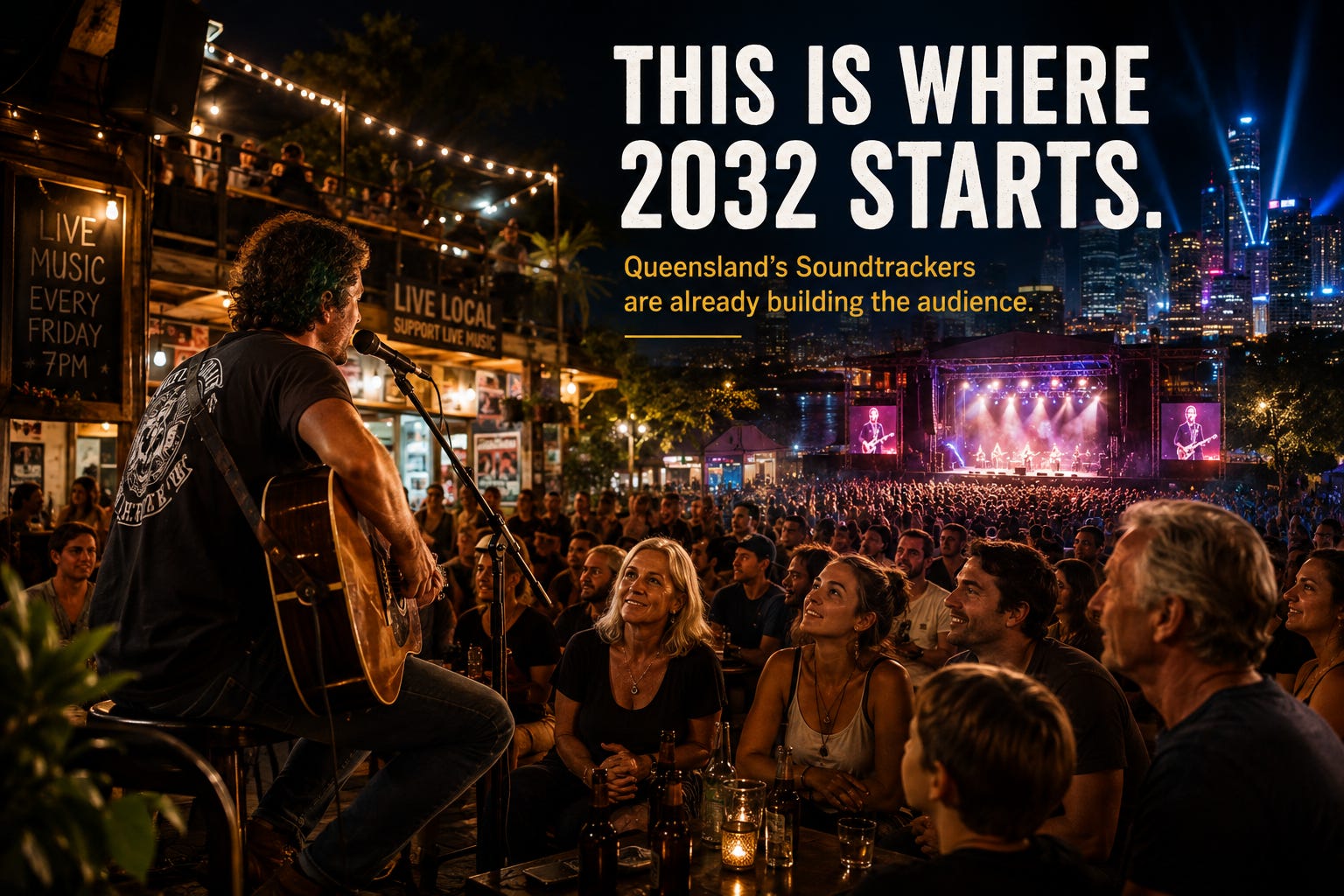
Hospitality venues are not arts organisations. They are businesses. They have wages, food costs, insurance, electricity, compliance, rent and a fairly spectacular collection of other expenses before someone suggests adding a band to Friday night. So entertainment has to work. When it does, the venue books again. One regular Friday gig creates 52 performances a year. Add Saturday and Sunday and suddenly one venue is providing more than 150 performance opportunities. Multiply that across Queensland.
That’s a serious market force. I won’t call it an industry because “spoiler alert” I do not believe there is one. There are lots of different music markets and sectors with completely different economics, customers and challenges. Pretending they are all the same is partly how we got here.
A fairly confronting experience during the COVID shutdowns left its mark on me. I was endlessly sourcing funding opportunities for musicians whose work had disappeared overnight. These weren’t people who had lost a couple of original gigs. For many of them, their entire annual income vanished in a second. I hounded Local, State and Federal MPs and vigourously campaigned State and Federal bodies to find whatever funding was available. One Queensland State Body mentioned that Arts Queensland had a packet of funding not yet allocated. I made a submission providing them with decades of data and metrics to support my case. Their response shocked me. Sound Tracker musicians, the ones that work week in and week out, were virtually invisible to these funding organisations. There was no understanding of the workforce size, their invaluable contributions to a healthy local hospitality bottom line and , honestly, no interest in the value at all. They would rather hand out $5000.00 each to original artists living in other countries than the actual Queensland artists who built the local scene to accommodate those original artists when they toured once in a blue moon.
Pre COVID lockdowns, we ran a label, curated releases, managed a small roster of original artists and toured a number of well known Australian recording artists across the country. We also worked closely with hospitality chains and promoters to book a consistent high standard of local sound tracking artists to build those business bottom lines. There was also a noticeable frostiness when it became apparent that we represented soundtrack acts as well as original artists - who ironically also sound tracked as it supported their original brand business.
There are no words…….
These musicians weren’t somehow less professional because they played songs people already knew. They were working musicians who had just lost their businesses. So when I now read about “targeted live music incentives”, my immediate question is: What data are we targeting them with? Do we actually know how many musicians are working every week in Queensland? How many gigs? Where? What are venues paying? Which markets are growing? Which are disappearing? Why are venues dropping entertainment? What stops a venue putting music on another night? What does it cost to keep a professional band on the road? How many musicians use soundtrack work to finance original projects? What happens to a regional music market when one key venue closes?
These aren’t academic questions. They determine whether an incentive actually grows something or simply pays for something until the funding runs out.
Which brings me to Queensland on Tour. I love the sound of this. Queensland absolutely should have stronger touring circuits. But putting venues on a map doesn’t create a touring circuit. A healthy local market does. If Townsville, Cairns, Mackay, Rockhampton, Bundaberg or Toowoomba has venues employing musicians every week, audiences become accustomed to consuming live entertainment.
Local musicians grow brands. Production develops. Venues learn what works. Audiences become more adventurous. Then you have somewhere meaningful to send a touring show. A touring circuit is only as healthy as the local markets it connects. And those little local gigs matter far more than they are given credit for. Because something else grows out of them.
Soundtrackers develop Queensland’s roster of touring Feature Tribute Shows. Metrics demonstrate very clearly that in 90% of cases, audiences prefer them to emerging artist shows. I know this because I have spent 35 years tracking what audiences will actually buy. Not what we think they should buy.
People want to hear the soundtrack to their lives. The song they fell in love to. The album they flogged to death when they were 19. The band they saw at Festival Hall. The song their dad played in the car. The one that instantly takes them back to somewhere they had forgotten existed.
There is nothing culturally inferior about that response. Music is memory. And memory sells a lot of tickets. A good Feature Tribute Show takes that relationship and turns it into a live experience. I don’t mean someone in a dodgy wig standing in front of a banner. I mean properly developed, beautifully produced Feature Shows performed by exceptional musicians who understand the material and know how to deliver it.
Those shows take years to build. They start with working musicians. Someone has an idea. They find the players. They test the repertoire. Some of it works. Some of it bombs. They change the arrangements. They work out what the audience actually wants. They improve the production. They design art that connects. They build a brand. Eventually, if they are good enough and commercially smart enough, they have a touring product.
That is the artist development that sound trackers self finance week after week and year after year.
When people arrive in Queensland for the Olympic and Paralympic Games, they aren’t only going to want to experience what Queensland sounds like in 2032. There is an extraordinary Queensland and Australian musical history sitting behind us. By 2032, many of the legacy artists who created that soundtrack may not be touring. Some won’t want to. Some won’t be able to. Some will no longer be with us. But people will still want to hear those songs.
Why wouldn’t Queensland start developing the shows capable of celebrating that history now?
Imagine high-quality Queensland productions celebrating different eras and stories of our music, touring Brisbane and regional Queensland during the Olympic period. Our musicians. Our producers. Our crews. Our venues. Our music history. And visitors from around the world experiencing it.
But we need to sow those seeds today. Not in 2031.
A Feature Show starting development today has six years before the Olympics. Six years to find its feet. To play some terrible gigs. To discover what doesn’t work. To get better. To build an audience. To develop the production. To tour regional Queensland. To work out the economics. To build the brand. To become genuinely bloody good.
This is where I think “incentives for local artist exposure” could become much more interesting. Don’t simply fund another gig. Build capacity into the musicians who are already working. Help them develop stronger music businesses. Help with production. Marketing. Touring costs. Digital assets. Business systems. Audience development. Professional standards. Insurance.
Help venues take chances on new Feature Shows and give those shows somewhere to develop. And please collect the data while we’re doing it. Find out what works. Find out what audiences buy. Find out what creates another 20 gigs rather than one subsidised gig. Then invest again.
As Queensland starts implementing this Action Plan, please make sure the people designing the future of the live music economy understand the people already keeping it alive. Talk to Soundtrackers. Talk to the venues that employ them. Look at their metrics. Understand how they work. Understand how many of them also create original music. Understand how local acts become Feature Shows and how Feature Shows become touring businesses. Understand what audiences are actually buying. Then decide where the incentives should go.
Because we don’t have six years to spend rediscovering a workforce that has been standing in front of us for decades. Queensland already has the musicians. We already have the venues. We already have audiences who love live music. And buried inside thousands of ordinary gigs happening across this state are probably some extraordinary shows that don’t exist yet.
2032 gives us a reason to start growing them now.
Reference:
https://www.nlec.qld.gov.au/
Nichola Burton has spent 35 years at the coalface of Queensland’s live music economy as co-founder and CEO of The Pushworth Group, working across thousands of gigs, tours, venues, artists and music brands. Now through Musoverse, she is turning that market knowledge towards the future: exploring how better data, stronger business skills and smarter systems can build capacity in the musicians who keep our venues playing week after week. She celebrates the Soundtrackers — the working musicians who build audiences, grow local markets and create the conditions from which great shows emerge. Because music culture isn’t built from the top down. It starts with the gig happening tonight.
