


If you’ve ever sat in your car outside a venue wondering why you still do this to yourself...
If you’ve ever felt like turning the ignition back on and driving home...
If you’ve ever stood behind the stage curtain with your heart pounding so hard you thought the audience could hear it...
Congratulations. You’re a gigging musician. Despite what Instagram might have you believe, stage fright isn’t a sign you’re in the wrong profession. It’s practically part of the job description.
It’s one of the questions I hear most. “I’ve played over a thousand gigs. Why do I still get nervous before every single one?” Because your brain doesn’t know you’re about to play Wagon Wheel to 80 people at the local. It thinks you’re about to be eaten by a tiger.
The human brain hasn’t evolved fast enough to tell the difference between physical danger and social danger. Standing alone under lights while dozens—or hundreds—of people watch your every move triggers the same survival system that once kept our ancestors alive.
Your nervous system simply hears: “Everyone’s looking at me.” Then it responds exactly as designed.
The moment your brain senses a threat, your sympathetic nervous system hits the panic button. Adrenaline floods your body. Heart rate increases. Breathing speeds up. Blood moves away from your stomach and into your muscles. Your pupils widen. Your body prepares to fight… ...or run.
Unfortunately, neither option works particularly well when you’re halfway through Sweet Caroline.
This is why too many musicians often experience:
A racing heart
Dry mouth
Tight throat
Sweaty palms
Shaky hands
Wobbly knees
Nausea
Tunnel vision
Racing thoughts
The overwhelming urge to disappear into the loading dock.
None of these symptoms mean you’re weak. They mean your nervous system is doing exactly what it evolved to do. Those butterflies? They’re often strongest before the first song.
Research consistently shows that performance anxiety usually reduces once the performance begins. Why? Because your brain finally receives new information. “Hang on... nobody’s attacking me.” “They’re actually smiling.” “Someone just sang along.” “I’m okay.” Your nervous system recalibrates.
That’s why so many musicians say: “The hardest part is walking onto the stage.”
Before a gig, your inner critic becomes a full-time employee. “You’ll forget the words.” “You’ll stuff the intro.” “Everyone will notice.” “You’re not good enough.”
Here’s the clinical reality. Thoughts are not facts. An anxious brain is a prediction machine. It constantly overestimates danger and underestimates your ability to cope. The trick isn’t eliminating those thoughts. It’s recognising them as background noise rather than the headline act.
If anxiety lives in your nervous system… Then breathing is the mixing desk. One of the fastest ways to reduce stage fright is something every musician already carries with them. Their breath. The science is surprisingly simple. Longer exhalations stimulate the vagus nerve—the body’s natural brake pedal—which shifts your nervous system out of fight-or-flight and towards a calmer state.
When you get to the gig, try the Cyclic Sigh. Take a slow breath through your nose. Before you exhale, take one short extra sip of air. Then slowly let the entire breath out through your mouth. Repeat five times. It sounds ridiculously simple. It works ridiculously well.
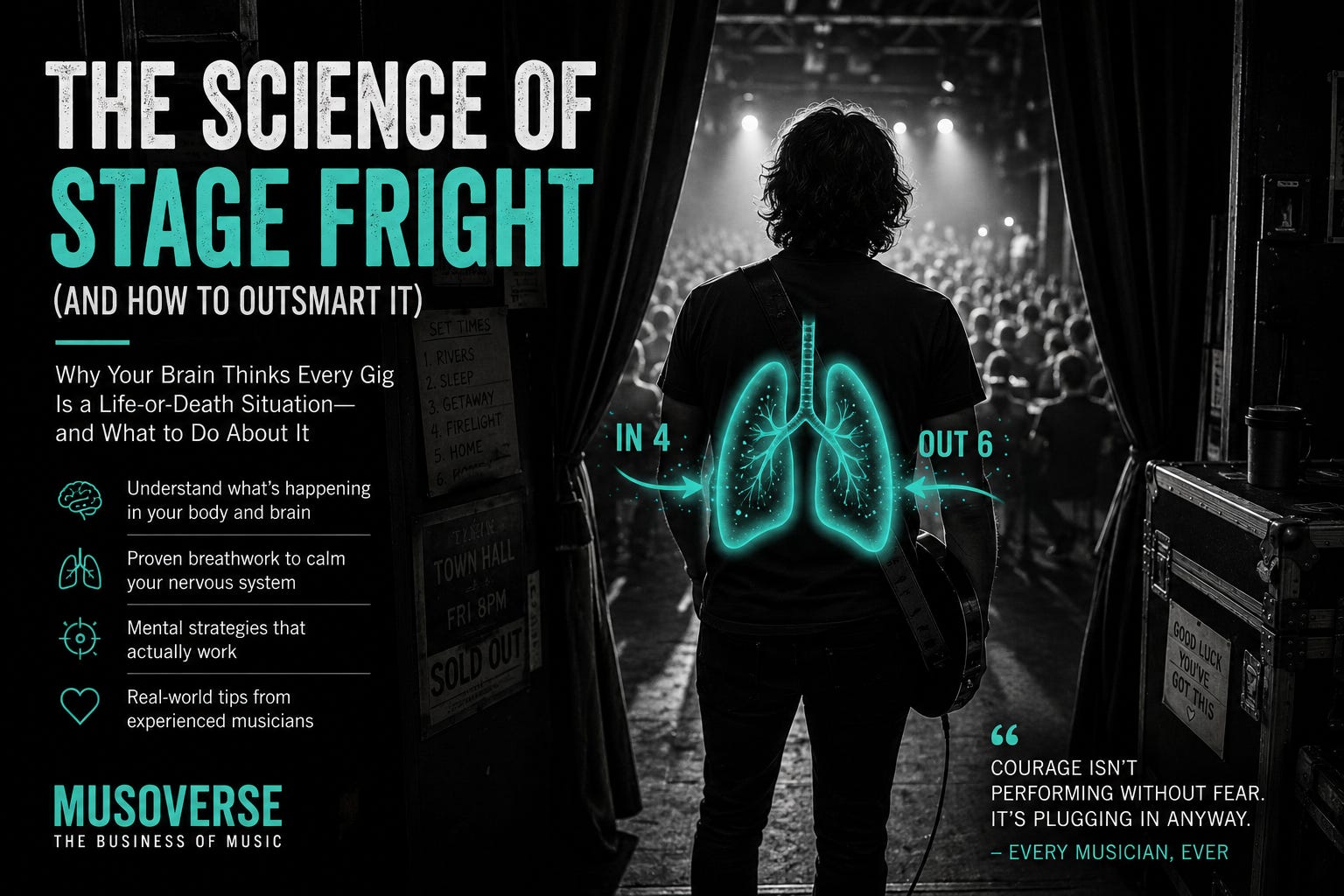
And when you walk on stage, forget taking huge breaths. Instead try this rhythm: Breathe in for 4 beats. Breathe out for 6 or 8 beats. That longer exhale tells your nervous system: “We’re safe.” Not eventually. Immediately.
Now if you are on the road and you’ve driven six hours... Ate servo food… Slept badly… Loaded in… Sound checked… Waited around… Played… Loaded out… ...your nervous system has been working overtime. A few minutes of Box Breathing (4 in, hold 4, out 4, hold 4) between gigs helps reset your baseline.
Think of it as tuning your nervous system before you tune your guitar.
Here’s something every experienced muso eventually learns. The audience wants you to succeed. They’re not sitting there hoping you’ll miss the second verse. They’re there because they want a good night. So forget about trying to be perfect.
Miss a lyric? Smile. Play the wrong chord? Keep going. Forget the bridge? Half the audience won’t even know. Confidence isn’t playing perfectly. Confidence is recovering gracefully.
Here’s an old trick. When you walk on stage, don’t scan the whole room. Find one friendly face. One person smiling. Play your first song to them. Your brain immediately stops seeing “a crowd.” It sees another human. And that changes everything.
Musicians spend thousands maintaining guitars. Replacing strings. Servicing amps. Buying microphones. But the most important instrument you’ll ever own is your nervous system. So look after the instrument behind the instrument. Sleep. Movement. Good food. Hydration. Less caffeine before the gig. A short walk around the block. Five minutes of breathing.
None of it is glamorous. All of it works.
If your stage fright has become so overwhelming that you’re avoiding gigs, cancelling work, experiencing panic attacks, or finding anxiety follows you long after the show ends, it may be worth speaking with your GP or a psychologist. Therapies such as Cognitive Behavioural Therapy (CBT) or even NLP have strong evidence for treating performance anxiety, and in some cases a doctor may discuss medical options where appropriate.
Asking for help isn’t a career-ending move. It’s often the thing that amplifies it.
You are not alone. Adele has spoken openly about stage fright. Bruce Springsteen still describes feeling nervous before walking on stage. Countless Australian musicians who’ve played thousands of gigs will quietly admit they still get butterflies.
Maybe the goal isn’t to eliminate fear. Maybe it’s simply to understand it. Because courage isn’t performing without fear. It’s plugging in anyway.
See you on stage.
Nichola Burton is CEO of The Pushworth Group and author for Musoverse, where she writes about the business—and the human side—of live music. As a gigging musician, she knows stage fright isn’t just a theory—she lived it. After years of walking onto stages with a racing heart and shaky hands, she discovered practical strategies that helped her perform with confidence. Today, after more than three decades working alongside thousands of Australian musicians, she shares the lessons she wishes someone had shared with her.
Copyright 2026
