

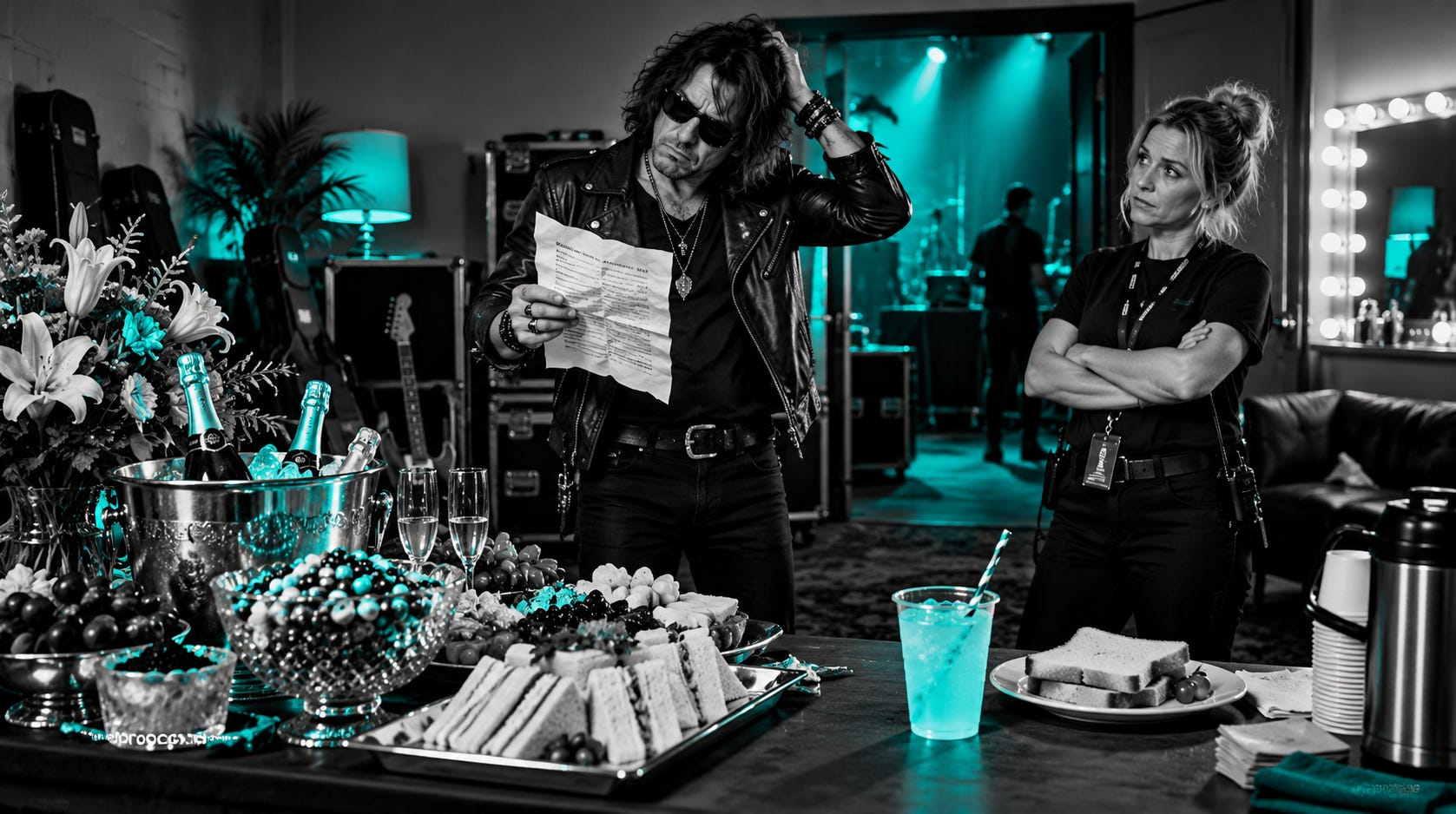
There was a time when being a rock star meant you could demand just about anything backstage. Champagne. Caviar. Exotic flowers. Lady GaGa may have famously included a request for a mannequin with puffy pink pubic hair to be placed inside her dressing room. And yes, Eminem actually requested a fully structured wooden pond filled with live koi carp in his private backstage garden area for a festival in Ireland in 2011. Fast forward to 2026 in Australia, you now may cause an international incident by offering a local musician a glass of post-mix lemonade.
So it’s time to retire the urban legend of what a hospitality rider actually is.
Having spent more than three decades working with artists on tour around Australia, I’ve collected some ripper backstage rider stories. Most are incredibly humble and gracious. A small percentage of artists are quite ridiculous, and there are some memorable moments where the long suffering hospitality staff exhibited a degree of patience normally reserved for negotiating with toddlers.
The hospitality rider emerged alongside the growth of international touring in the 1960s and 1970s. Its original purpose was to make sure that musicians and crews travelling from city to city had access to food, water, somewhere to change and somewhere to recover between shows. The technical rider specified what was needed to deliver the performance. The hospitality rider specified what was needed to look after the people delivering it.
Van Halen famously demanded a bowl of M&Ms with all the brown ones removed. David Lee Roth later explained it was a test to see whether promoters had read the band’s complicated technical requirements. While Iggy Pop’s rider famously requested a Bob Hope impersonator, other artists requested increasingly elaborate backstage comforts. The rider had become part of the mythology of rock and roll. Not just what you needed, but what you could get away with asking for.
And for some artists, it became the ultimate confirmation that they’d made it.
Cue one emerging international band, hot on the heels of their first number-one hit. We had booked their first Brisbane concert at the Entertainment Centre. One minute, they were young, hopeful up-and-comers. The next, their song, was sitting at number one, and they were embarking on a world tour. The transition had taken months, not years. A whirlwind of interviews, airplay, screaming fans and instant adulation. They’d gone from dreaming about fame to living it before they’d had much time to work out what it actually meant. And somewhere in that whirlwind, the vocalist apparently decided that the appropriate response to sandwiches arriving backstage with their crusts still attached was to slap the caterer. Hard. It was an extraordinary display of bad manners from someone who had apparently mistaken a hit record for a diplomatic passport.
But what fascinated me was the psychology behind it. To these young artists, the hospitality rider wasn’t simply a list of practical requirements. It had become a measure of their newfound power and value. The backstage treatment. The special requests. The people running around making everything happen. They’d made it. And the rider was proof. What they hadn’t yet worked out was how the business actually operated, or that the people delivering their sandwiches were professionals doing their jobs, not servants attending to royalty.
Interestingly, as their career progressed, so did their manners. The demands became more reasonable. The behaviour settled down. They gradually grew into the professional responsibilities that came with their success. Experience eventually caught up. And while the band may have moved on from that unfortunate afternoon, those of us standing backstage never forgot it.
Then there was a very famous Australian act. One enormous number-one hit that kept them in the public consciousness for decades. They didn’t perform very often. When they did, it was something of a reunion. The players got together, the old mates turned up, and memories and drinks flowed in equal measure. The green room inevitably filled with friends, acquaintances and the sort of hangers-on who can smell complimentary alcohol from three suburbs away.
And the hospitality rider? Well, apparently that was a community resource. We’d regularly hear from promoters afterwards. Not only had the entourage consumed the rider, but some had helped themselves to the stock behind the green room bar. Backstage at their concerts became known as an all-inclusive reunion package with the promoter being expected to simply absorb the cost.
It was a fascinating example of how something provided as hospitality could quietly become entitled ownership.
Those two experiences stayed with me over the years because they illustrated two different attitudes to success. One act was learning how to handle fame. The other had become rather comfortable with its privileges. Neither story was really about food or alcohol. It was about expectation and entitlement.
And all the while, the Australian hospitality industry was transitioning; the days of leaving several cartons of beer and a couple of bottles of spirits backstage and hoping for the best had become slightly more complicated.
In Queensland, licensed venues operate under the Liquor Act 1992 and the oversight of the Office of Liquor and Gaming Regulation. Responsible Service of Alcohol isn’t optional. Neither is compliance with the Work Health and Safety Act 2011. Musicians working as independent contractors are still workers for WHS purposes. Which means venues have to consider what happens when somebody who’s been enjoying the hospitality rider starts operating electrical equipment, navigating stage cables or dealing with an enthusiastic audience.
The venue also has to consider its licence conditions, insurance exposure and the other small administrative inconveniences involved in operating a legal business. None of this means a venue can’t provide complimentary alcohol. It can, subject to the applicable rules. It just means that “But it’s on our rider” isn’t a particularly compelling response to a liquor licensing inspector.
So here we are. The hospitality rider has survived rock and roll excess, the rise of responsible service legislation and several generations of questionable backstage behaviour. And yet we’re still weathering complaints about complimentary drinks.
Commercial arrangements for hospitality vary from promoter to promoter. Some offer meals. Some offer drink vouchers. Some provide water and soft drinks. Some negotiate comprehensive hospitality arrangements. Others provide exactly what was agreed in the booking contract. Yet unfortunately there are still occasions when an artist throws a tantrum when offered post-mix lemonade as though the venue has personally insulted their artistic legacy. Or demand free meals for themselves and their family, the odd vodka, lime and soda or a sneaky six-pack backstage.
We need to bring the whole Riders conversation back to business.
50% of show contracts will include hospitality riders. 50% won’t. I think it’s important to note that riders are not wish lists or standard industry arrangements. A touring act travelling hundreds of kilometres with a crew and a twelve-hour production schedule will have legitimate catering requirements. These will be negotiated in advance with the promoter signing off on their rider agreement. A local soloist driving twenty minutes to play a three-hour show may have a very different commercial arrangement in place.
Each independent music business negotiates the costs of delivering their show. Travel. Accommodation. Production. Hospitality. Tech. The promoter then decides whether those terms work for its business. If you are lucky enough to be employed by a producer or a promoter under the Live Performance Award, they may provide meals and other entitlements. However, the majority of independent contractors are subject to negotiation for rider arrangements as governed by liquor licensing and workplace safety obligations.
So in 2026, for the most part, the industry has traded the backstage free-for-all for contracts, compliance, commercial negotiations and the occasional complimentary chicken parmigiana. The hospitality rider still has its place. If you’re touring, negotiate what you need. If you’re playing locally, know what’s included. Agree before the gig, not during a spirited debate with the bar manager halfway through your second set. And when a venue offers a little extra hospitality, show your gratitude. Be gracious.
And next time somebody offers you a complimentary lemonade, remember: the rider might be rock and roll, but somebody still has to pay the bar bill.
Nichola Burton is the CEO and co-founder of The Pushworth Group, with more than three decades navigating the wonderfully ridiculous business of Australian live entertainment. Through Musoverse, she’s building a practical business education hub for independent Australian musicians, turning decades of industry experience into accessible knowledge, guides, tools and resources. The mission? Help artists move beyond simply playing gigs to building professional, profitable and sustainable music businesses. Less guesswork, more business nous, and plenty of backstage stories along the way. Preferably without slapping the caterer. Copyright 2026
