

There is an email that arrives in our agency inbox with remarkable regularity.
Why aren’t we getting more gigs?
Sometimes it comes from an experienced cover band. Sometimes from a relatively new act. Often accompanied by a showreel, a biography, a photograph and a playlist of songs that everybody knows.
They’re good musicians. They can play. They’ve rehearsed. They’ve invested in equipment. They’ve done the work. And they genuinely cannot understand why the bookings aren’t rolling in.
So the bookers will ask for feedback from venue managers. And the answer is often much the same.
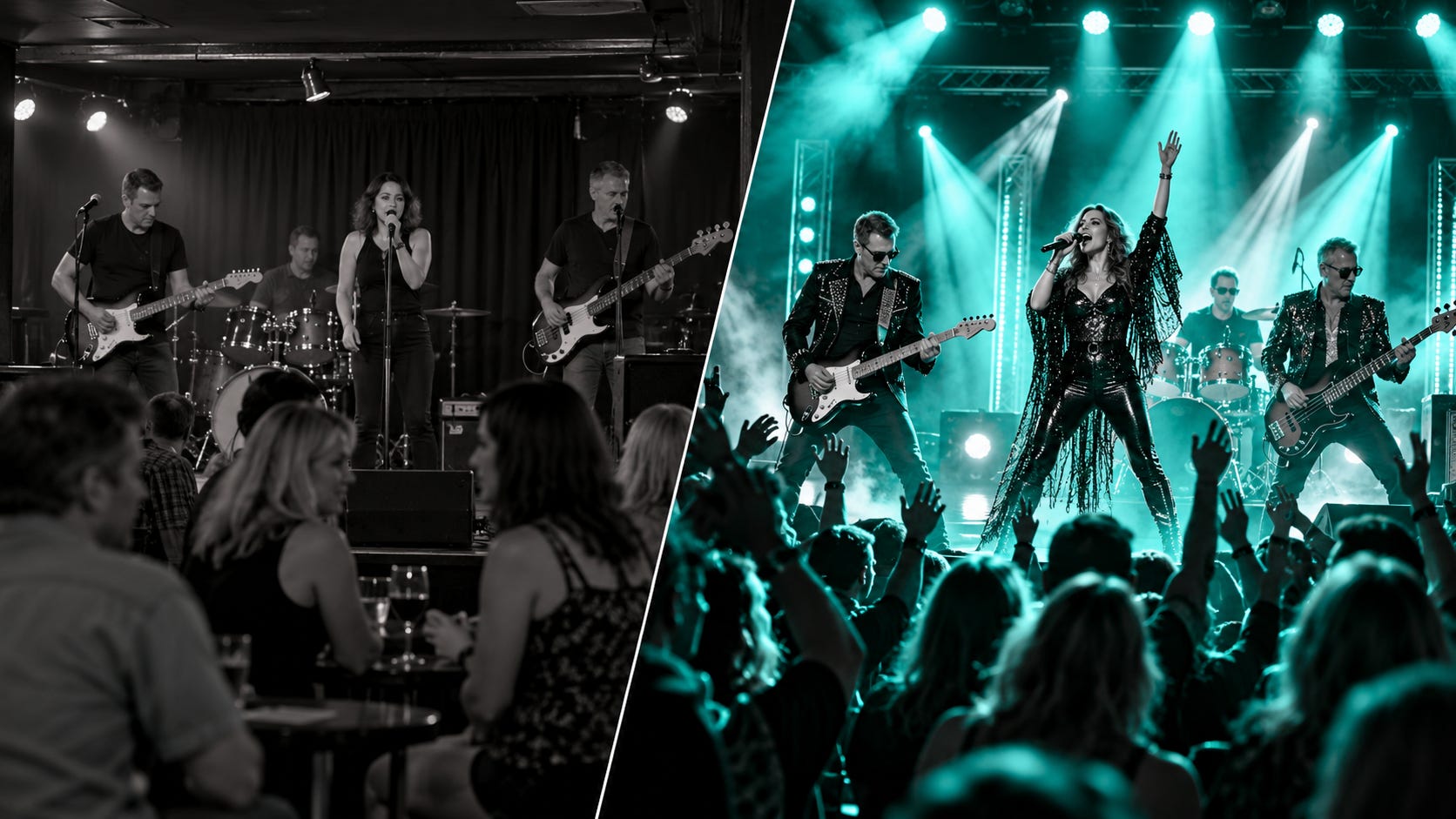
They sound like every other cover band.
Not necessarily better. Not necessarily worse. Just the same. Just another band playing the same songs, looking much the same, sounding much the same and offering much the same experience.
And therein lies the problem.
Being a good musician doesn’t automatically make you a commercially attractive entertainment product.
Welcome to a very crowded market! There are plenty of competent musicians in Australia. Plenty of cover bands that can play Summer of ‘69, Dancing Queen, Mr Brightside and Don’t Stop Believin’. And there is absolutely nothing wrong with any of that. But when a venue has twenty acts offering a similar playlist, what makes yours the one they should book?
That’s not a question your agent can answer for you. It’s your business. Your brand. Your responsibility. At Musoverse, we’ve published plenty of resources to help you understand how to develop and market your Music Brand. But no amount of advice can manufacture the one thing you need to discover for yourself.
What makes you different? And these are two pieces of business language worth understanding.
POD — Point of Difference.
What distinguishes your act from the other performers competing for the same bookings?
USP — Unique Selling Proposition.
What is the compelling reason a venue, promoter or ticket buyer should choose your act over the alternatives?
Your POD is what makes you different.
Your USP is how you turn that difference into a reason to buy.
And no, we’re professional, reliable and play a great mix of hits is not a USP. The market isn’t asking whether you love what you do. It’s asking what you deliver that somebody else doesn’t.
When we ask venues what they want from their entertainment, the conversation increasingly goes beyond musicianship. They want performers who connect with people. Artists who engage an audience rather than simply play at them. Acts with an active social media presence, a recognisable brand and a genuine relationship with their followers. They want to see what happens when you perform. Do people sing along? Dance? Stay longer? Bring friends? Come back? Does your social media show an audience having a good time, or does it consist of a poster announcing your next Saturday night gig? Are you creating interest in your gigs or waiting for the venue to create that interest for you?
A venue doesn’t just buy two or three hours of music. It buys the potential for an experience that gives people a reason to turn up. And the more clearly you can demonstrate that experience, the easier you make the buying decision.
We are seeing demand for entertainment that offers audiences something more specific than another night of familiar covers. In particular, tribute and themed shows built around one or two recognised artists can offer a much clearer proposition.
So you may find yourself at a point where its time to consider taking your audience on a new journey. What experience could you offer them? Is there one artist, era, catalogue or story that might be intriguing enough for an audience?
Something key to remember here, though. Playing fifteen songs by the same artist doesn’t automatically make you a tribute show. You are going to have to develop the show. And that begins with some deeper questions.
Let’s start with you on stage at one of your gigs. What are the songs where something genuinely happens between you and the audience? Which songs feel completely natural when you perform them? When does the whole band lock in and the performance just flows? Which songs consistently generate the strongest audience response? When do people stop talking and start watching? Which performances produce the biggest singalongs, applause or dance-floor reaction? Which songs do audiences ask you to play again and again?
Pay attention to those moments. They may be telling you something about where your greatest commercial potential lies. You might think you’re a decent all-rounder cover band. Your audience might be telling you that your strongest identity is somewhere much more specific.
So which artist could you credibly build a show around? Not which artist is currently popular. Not which tribute show appears to be making money. Which artist can you genuinely deliver? Ask yourselves:
Does your vocalist have the range, character and presence to carry that catalogue?
Does the band have the musical ability to reproduce the arrangements convincingly?
Do you understand the artist’s music beyond the obvious hits?
Is there enough material to build a compelling 75–120 minute performance, or an appropriate two-set format?
Could you perform this music night after night and still believe in it?
Is there a recognisable audience for this artist in the markets where you want to work?
If you’re considering two artists, ask why they belong together. A shared era? Musical influence? Rivalry? Genre? Audience? There needs to be a reason beyond the fact that you happen to know both catalogues. A strong pairing gives audiences a story they can understand in one sentence.
And what is the show actually about? What is the story that you are telling on stage? This is where many musicians lose momentum. They think the set list is the show. It isn’t. A show takes an audience somewhere. Think about the artist you’re celebrating. What was their story? What made their music matter? What was happening culturally when those songs were released? How did their sound evolve? What would make an audience feel they were experiencing something more than a sequence of familiar songs?
When you are evaluating the journey you wish to take the audience on look at the following:
The opening: What happens in the first five minutes that tells the audience they’re in for something special?
The build: How do you move through the catalogue, introduce the stories and create anticipation?
The emotional moments: Where do you give the audience space to remember, reflect or connect?
The climax: Which songs create the biggest collective response?
The finish: What do people leave talking about?
You are not simply reproducing music. You are designing an audience experience. And that takes thought, rehearsal and creative direction.
So what does the audience see? If you’re going to build a tribute show, consider the entire presentation. What does the band look like? Is there a visual identity that reflects the artist, era or story? Do costumes make sense? Would a lighting design help create atmosphere? Do you need video content, projected imagery, staging elements or particular instruments to deliver the experience? How does the vocalist address the audience? Are the introductions rehearsed? Does the show flow between songs, or does everything stop while somebody tunes a guitar and asks the drummer what comes next?
Production value doesn’t necessarily mean expensive production. But it does mean deliberate production. A carefully developed show with modest equipment can be far more compelling than a collection of musicians surrounded by expensive gear and no creative direction.
So what does your music brand look like? Imagine you’re a venue manager. You receive two pitches. The first is from a cover band with a group photograph, a list of songs and a paragraph telling you they’re available for weddings, pubs, clubs, parties and corporate functions. The second presents a clearly defined show. A recognisable name. Strong visual branding. A professional showreel. An engaging description. A defined audience. A convincing performance.
Which one is easier to understand? Which one is easier to promote? Which one gives you a clearer reason to book it?
Your Music Brand needs to communicate the experience before anyone hears the first note.
Consider:
Show name: Does it communicate what you’re offering?
Visual identity: Do your photography, artwork, costumes and presentation belong together?
Showreel: Does it demonstrate the actual show, not merely a collection of disconnected clips?
Description: Can you explain the audience experience in a few compelling sentences?
Social media: Does your content reinforce the identity of the show?
Audience: Can you identify who is most likely to buy a ticket or attend?
Pitch: Have you made it easy for a venue or promoter to understand and sell the show?
And while you’re at it, check the rights involved in using artist names, imagery, recordings, logos and other protected material. Celebrating another artist doesn’t give you automatic permission to use their intellectual property.
The next question is who is going to buy a ticket? A tribute show is not automatically a commercial success. Just because you love an artist doesn’t mean there are enough people in your market willing to pay to see a tribute to them. Before investing in production, research the audience. Who are they? How old are they? Where do they live? Are they still actively listening to that music? Are similar shows already touring? What venues are presenting them? What are people paying for tickets? And most importantly, can you identify a genuine opportunity rather than simply adding another version of an existing show to an already crowded market?
There is a difference between having a creative idea and having a viable entertainment product. You need both.
Developing a show is only the beginning. Somebody needs to manage the brand. Somebody needs to organise the rehearsals, creative assets, production requirements, social media, budgets and bookings. Somebody needs to measure what works. Somebody needs to keep the whole thing moving when the initial excitement wears off. If you’re operating as a band, you also need to agree on who owns the Music Brand, who makes decisions, how revenue and expenses are managed and what happens when somebody leaves. Because a successful show can become a valuable business asset.
And that’s worth protecting.
An agent can provide market feedback. We can explain why a venue has passed on a pitch. We can tell you what buyers are looking for and what opportunities we’re seeing. We can help connect a market-ready entertainment product with potential customers. But you have not engaged us to discover your artistic identity, design your show, create your branding, develop your social media strategy or build your business from scratch.
That’s your gig.
If you want somebody to do that work for you, you need to engage the appropriate creative, marketing or management professionals and budget accordingly. An agent is not an unpaid business development department. And a booking enquiry is not a request for a complimentary brand consultancy.
Perhaps the next time you’re tempted to email your agent asking why you’re not getting more work, start with a different question.
If I were a venue manager choosing between twenty acts, why would I choose mine?
If you can’t answer that clearly, neither can the venue. And if your audience can’t recognise what makes you different, you’ve got some work to do.
That doesn’t mean every cover band needs to become a tribute show. A genuinely engaging, distinctive cover band can absolutely build a successful business. But whether you’re performing familiar covers, developing an original concept or creating a fully produced tribute, the commercial challenge is the same. You need to give people a reason to choose you. Not just a reason to listen. A reason to remember. A reason to turn up. And a reason to come back.
Because the market doesn’t owe you bookings simply because you’ve learned the songs.
The songs might be somebody else’s.
The Music Brand is yours to build.
Nichola Burton is the co-founder and CEO of The Pushworth Group, working at the business end of Australian live entertainment since 1991. After decades of watching what gets booked, what gets overlooked and what audiences actually turn up for, she knows that talent alone doesn’t build a career. Through Musoverse, she shares the commercial realities, practical tools and industry insights musicians need to stop thinking like performers and start building Music Brands that mean business. Copyright 2026
