

There is a famous Saturday Night Live sketch in which Christopher Walken, playing record producer Bruce Dickinson, listens to Blue Öyster Cult recording Don’t Fear the Reaper and identifies exactly what the song needs.
More cowbell.
They try again. More cowbell. Again. Still not enough cowbell. Until finally, “Guess what? I got a fever, and the only prescription is more cowbell!”
Weird how I only heard ‘cowbell’ while reading Queensland’s new Nightlife Economy Action Plan 2026–2032?
Queensland needs a stronger nightlife economy. Venues are struggling. Audiences have changed. People are buying tickets later. Hospitality costs have risen. Touring is expensive. Live entertainment is competing with Netflix, sport, gaming, restaurants and the increasingly seductive proposition of staying home in your jammies.
And bless JC in his submitted plan prescribing more opportunities, support slots, touring pathways, promotion and support for local and grassroots artists - all simply the equivalent of adding more cowbell to a market struggling.
But, um, there is one key person missing from JC’s strategy.
The customer.
The reality check is that Queensland doesn’t have a shortage of musicians or songs or bands wanting gigs. There is an abundance of supply.
What we’re running short of is the audient – the customer purchasing, meals, drinks and tickets. The market gap is the humans prepared to get dressed, leave home, drive somewhere, park, buy a ticket, buy dinner, buy a drink and spend several hours experiencing live entertainment when they could remain horizontally committed to the sofa.
The bottom line here is that you cannot solve a demand problem by creating more supply. You cannot solve an audience problem by creating more things for the audience not to buy.
Let’s start here. Artist development is not market development. Supporting artists is legitimate cultural policy. Art doesn’t have to turn a profit to have value. But this document isn’t called the Queensland Let’s Give Musicians a Hand Action Plan. It’s the Nightlife Economy Action Plan. (A)
An economy requires a market. A market requires a customer. And customers don’t read funding guidelines or care which genre has been designated culturally desirable this financial year. They simply ask, ‘Do I want to go to this?’
Meet Bec. Apparently no one asked her. She is 48. Lives in Carindale. Has a job, a mortgage, two kids and a husband she’s quite fond of, plus three mates from high school that she keeps promising to catch up with.
The best part is that Bec has $200.00 to spend on Saturday night.
So what will it take for Bec to open the group chat and type, “Girls? You in?”
It could be Brisbane’s second-best covers band, a Fleetwood Mac tribute show, an emerging Queensland singer-songwriter, Jimmy Barnes, or a DJ playing the hits that Bec danced to in 1992 while making several spectacularly poor romantic decisions.
Bec doesn’t know it yet, but by leaving the house and choosing a venue to spend the night with her mates, she is participating in Queensland’s cultural economy. Multiply her by 500 and suddenly we’ve got ticket revenue, bar revenue, meals, Ubers, hotel rooms, technicians, security staff, musicians and a venue that wants to do it again next month.
Perhaps we should ask Bec what she wants? 🙂
The Queensland Greens have proposed spending $6 million every year bringing live music into 50 Brisbane community venues, leading to almost 2,400 original performances every year. (B)
What if 40 people turn up for the original music gigs that the Greens think should be heard, and 500 Bec’s head somewhere else to party to a 90s DJ instead? Are we building a live music economy? Or providing musicians with government-funded opportunities to add another gig to their resume?
Original music is part of the market. But it isn’t the entire market.
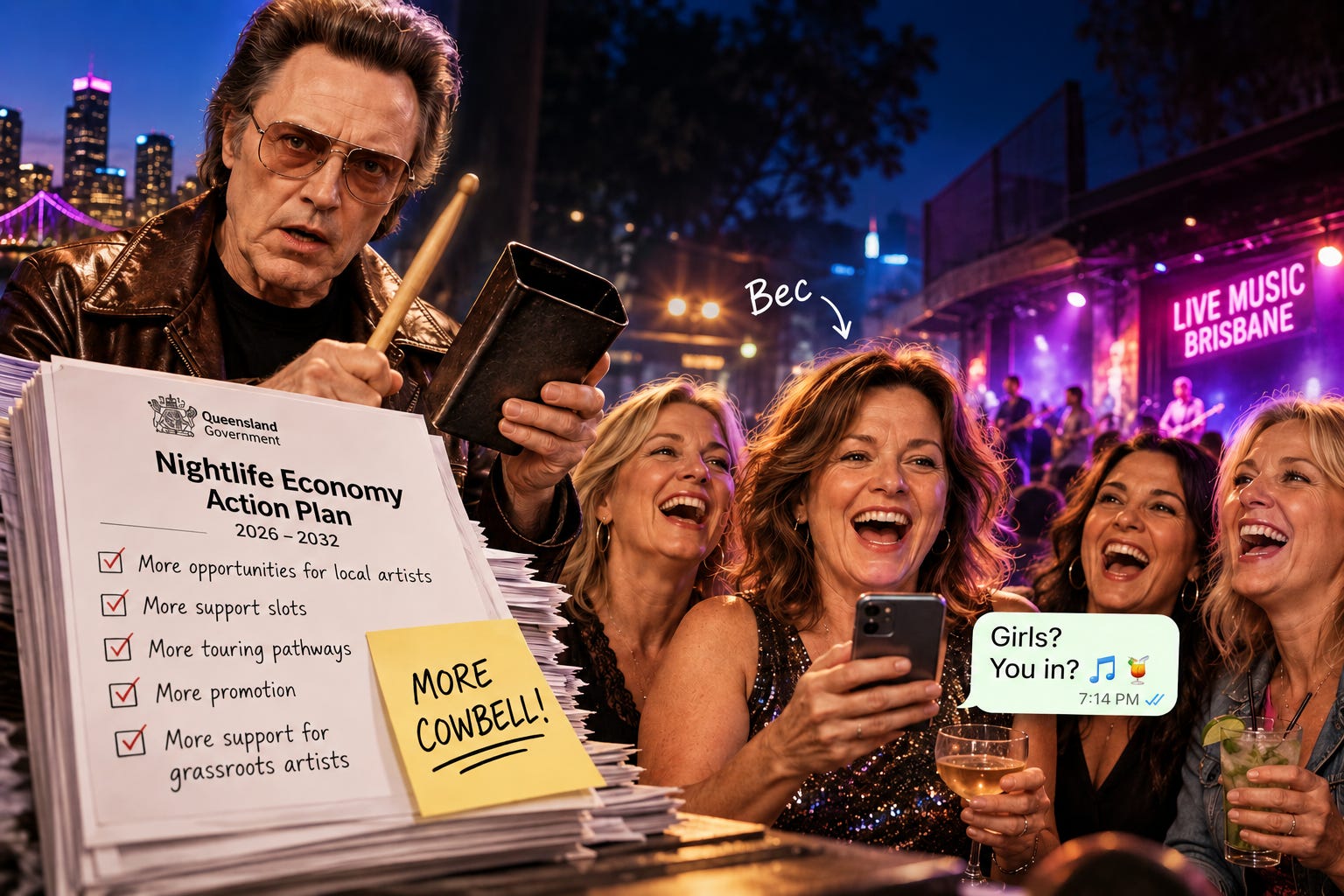
Bec doesn’t decide to go out to spend that $200.00 and party with her mates to support live music. She is headed out to party, to listen to her soundtrack and to seek out music that will become her time machine for a few hours.
So if we’re genuinely talking about a nightlife economy, we kinda have to factor Bec into the mix because ultimately she owes us nothing.
So let’s discover the ultimate Bec. Map the venues, capacities, audiences, age, geography, genre preferences, ticket price tolerances, travel patterns and historical sales. Track what works in Cairns, Toowoomba, Gold Coast or Ipswich. What gets 500 people into a regional club? What gets Bec and the girls into an Uber?
It’s time to follow the audience as a matter of priority. Don’t just count artists receiving opportunities. Let’s count how many heads, tickets sold, venues expanding, hospitality spending, regional travel, repeat attendance, and commercially sustainable shows.
A thriving healthy nightlife economy needs to offer more reasons for people to go out and experience it. So let’s make it count and ask, “What would make Queenslanders want to go out tonight?”
And before anybody reaches for another artist-development programme to fix an audience-development problem, for god’s sake, put down that bloody cowbell.
References
(B) https://greens.org.au/qld/bcc/ban-pokies
Nichola Burton has spent more than three decades in Australia’s live music industry, connecting artists, venues and audiences. She writes Musoverse from the unfashionable end of the telescope: the customer. Because without an audience, there is no music business — just a lot of cowbell. Copyright 2026
