

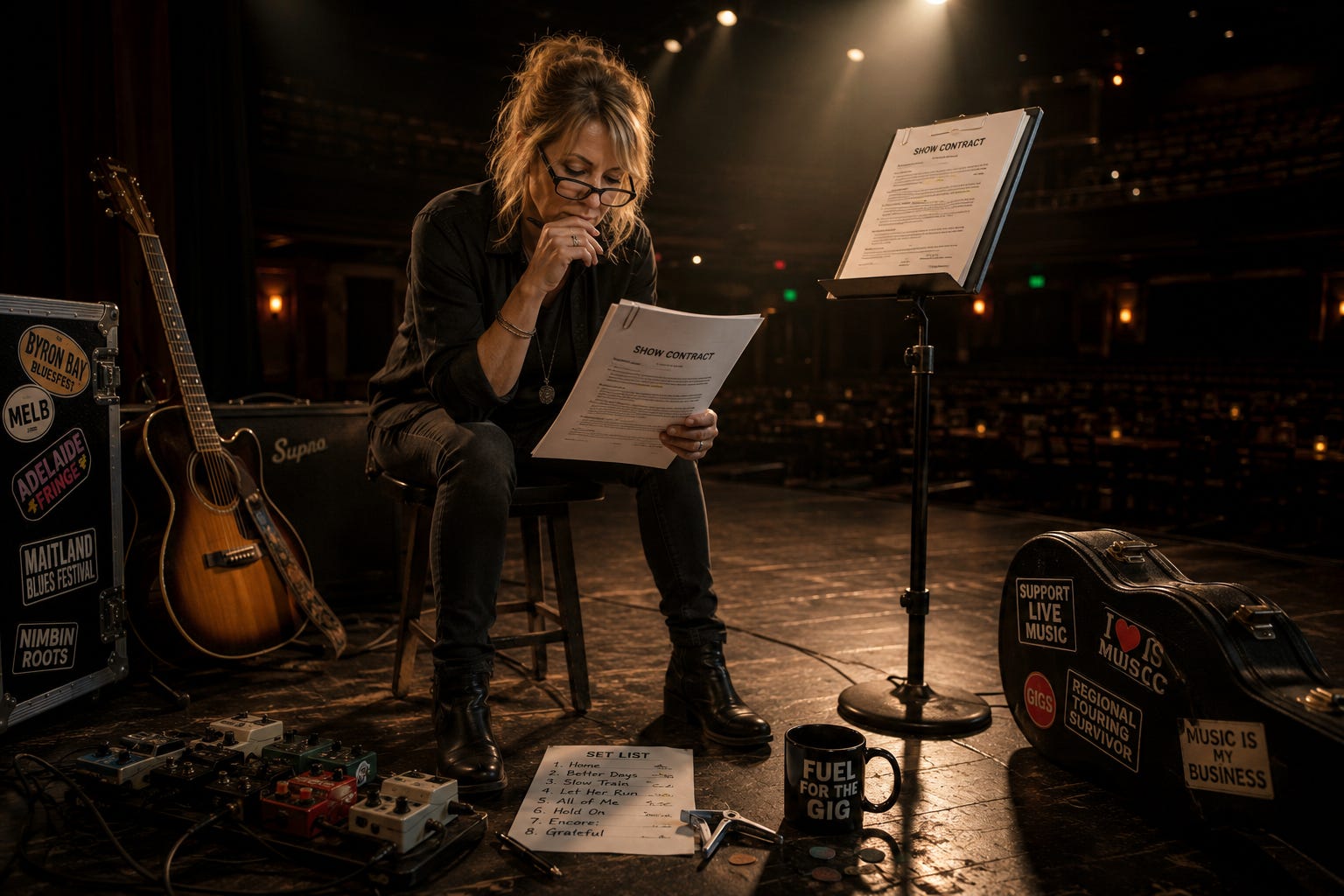
Question: How often do you actually read your Show Contracts? Not just to check the date, the venue and your performance fee—but to understand the agreement you’re entering into. Every contract sits within a much bigger framework. The Terms and Conditions you accepted when you first onboarded. The Supplier Code of Conduct. The FAQs. The policies that explain how that business operates.
Do you click every link and read the information? Or do you simply rely on the spectrum of urban myths instead?
Since 1 July, inboxes across the country have been overflowing with questions like: “Why has my fee been reduced?” “Where did my super go?” “Who’s my employer?” “Why is my contract different?” “Why wasn’t it done this way before?” “Why is everyone telling me something different?”
Before 1 July 2026, if you were operating as an independent contractor under a Sole Trader ABN, you were running a business that might have consisted of one person and a guitar or six musicians, a lighting rig, backing tracks and a van.
It didn’t matter. You invoiced. You were paid. You managed your own taxation. Your own GST (where applicable). Your own superannuation.Any other performers you may have sub contracted in your show.
Post 1 July 2026, the current legislation now places responsibility on the customer engaging eligible entertainers to ensure Superannuation Guarantee is paid. If a venue books your show through a marketplace or agency, that marketplace or agency will often administer the payment of Superannuation Guarantee on the venue’s behalf.
That’s the one administrative change. Not your value. Not your talent. Not necessarily your overall engagement value. Just the pathway the money takes. The money is still yours it’s just that now one of the destinations changed. The ownership didn’t.
The biggest revelation of the past month has been that not every booker operates the same way. A few operate under a Private Employment Agent Licence. Most don’t. Some require every supplier to register and onboard before accepting work. Others don’t. Some provide comprehensive Terms and Conditions. Supplier Codes. FAQs. Privacy Policies. Contracts for every show booking. Clear explanations of how they operate. And others that operate with considerably less documentation.
Neither approach automatically makes one business right and another wrong. But the difference is much clearer post 1 July.
Whether you perform once a month or five nights a week, you’re not just a muso. You are a business owner. And this means that understanding your agreements is just as important as your set list.
I reckon that the past few weeks haven’t actually been about Superannuation at all. They have been about business literacy.
So tonight, instead of learning another song, consider spending thirty minutes learning all about your own business. Visit the websites of the agencies, marketplaces and businesses you work with. Read their Terms and Conditions. Read their FAQs. Find their Supplier Code of Conduct or Code of Practice. Then take a closer look at your Show contracts. Understand who is responsible for what. If you work with several different bookers, don’t assume they all operate the same way. They almost certainly do not. Every agreement creates a different commercial relationship. And every commercial relationship creates different rights, responsibilities and obligations.
Bottom line - when music means business, it’s not just what happens under the lights. It’s what happens before the first note is played—understanding your contracts, your obligations and the business you’re running every time you step onto a stage.
Nichola Burton is an author, music industry executive and systems thinker with an incurable habit of asking awkward questions. After more than three decades working behind the scenes of Australia's live music industry, she's learned that the biggest challenges rarely happen on stage—they happen in the paperwork, policies and systems that most people never read. Through A Little Pitchy, she translates complex industry issues into plain English, encouraging musicians to think not just as performers, but as business owners. Because talent gets you the gig. Understanding the business helps you build a career. Copyright 2026 All rights reserved.
