


To be honest, I have written a lot about this subject over the past year. And my concerns and questions remain unanswered despite several ruling requests from the ATO, which is a terrible reflection on them and our industry as a whole. What a total shit show! I’m loathe to write about this again but here we are.
Let us begin with the part nobody is arguing about. Artists deserve superannuation. That is not the dispute. The dispute is whether a legitimate business—delivering a complete show, carrying its own costs and accepting its own commercial risk—should be treated as though it is merely an individual turning up to supply labour.
Because that is not how most of this industry works.
For example, our business model (Pushworth) is built around brands that operate as legitimate businesses. They do not simply arrive, stand in a corner and transmit songs for three hours. They are contracted to deliver a result. That is the entire meaning of our trademarked phrase: Music Means Business™.
A venue books a gig because it wants something to happen. It may want to attract or retain patrons, increase food and beverage sales, create atmosphere, activate a quiet trading period, build a particular venue identity, sell tickets, support a promotion, increase repeat visitation or create an experience its customers will remember.
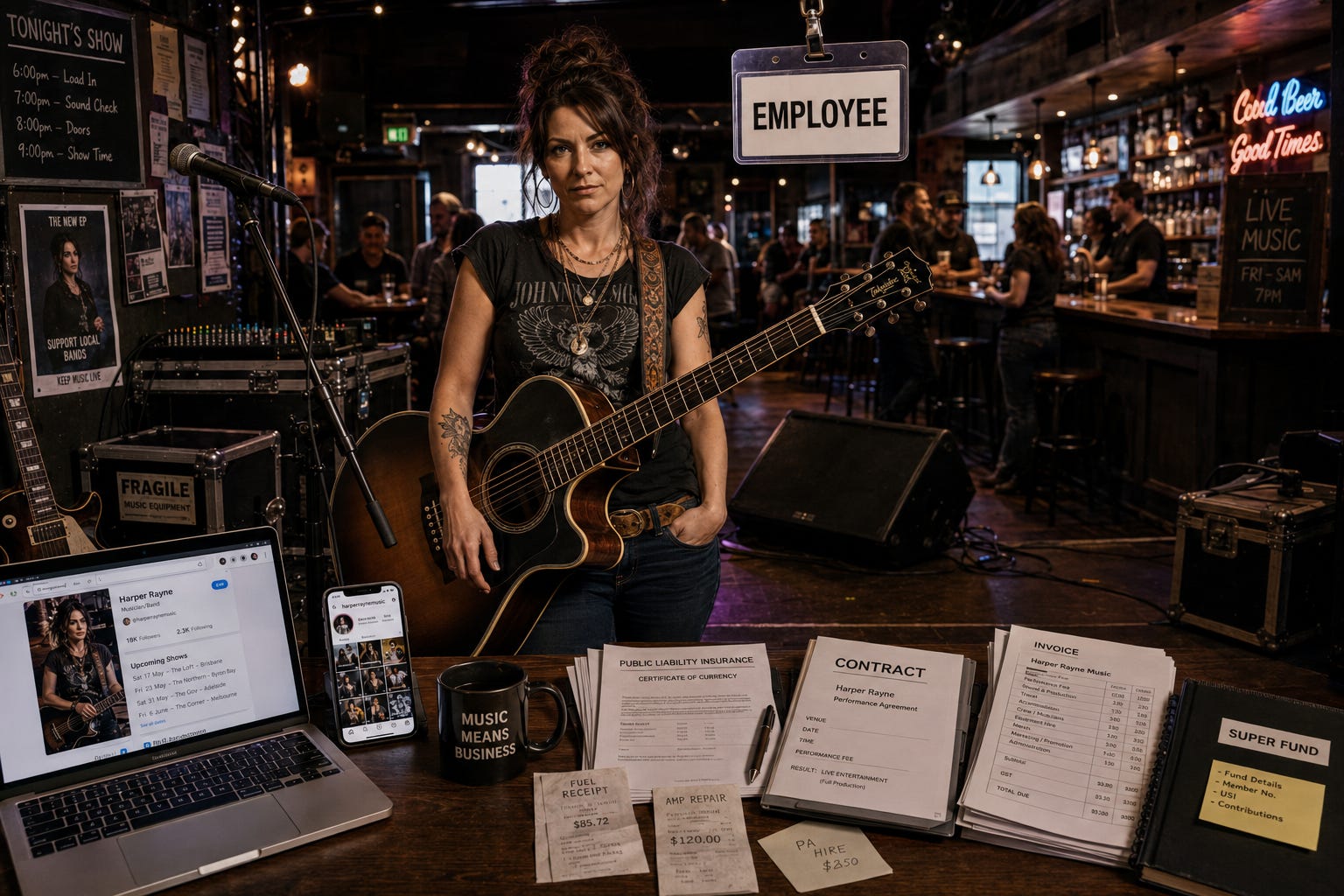
The Artist is contracted to help achieve that result and arrives with far more than a voice and a pair of hands. Some of the myriad of things they provide are a recognised artist or act name, repertoire developed over years, instruments, sound equipment, lighting, transport, production, rehearsals, arrangements, insurance, marketing assets, photography, reels, social media promotion, an existing audience, managed, substitute and/or subcontracted performers, and the commercial systems required to deliver the show.
I man, that is a business supplying a service. Except, apparently, when the invoice is paid to a Sole Trader ABN. At that moment, the performer may be treated as an employee for Superannuation Guarantee purposes.
Welcome to the current chaos.
The Superannuation Guarantee rate is 12 per cent. That is the simple part. The ATO now states that if an individual is paid to perform or present any kind of performance, that individual may be considered an employee for superannuation purposes. It also says SG is calculated on the component of the invoice relating to the individual’s work.
That last sentence opens a rather important trapdoor. What component of a Performer’s invoice relates to their “work”? All of it? Some of it? The time on stage? The rehearsals? The equipment? The promotion? The insurance? The production? The audience they bring? The Performers they subcontract? The intellectual property embedded in the artist brand?
Nobody from the ATO has supplied a workable formula. We have asked. Repeatedly. And yet…….Crickets. Will our third ruling application get answers? I mean, it’s bloody high time that they provided an answer that can actually be applied to thousands of real life engagements.
A Live Performer is not an empty handed unit of labour. The current interpretation begins to fracture the moment it touches the actual industry. A typical sole trader performer may:
operate under an ABN;
invoice for a completed engagement;
work for dozens of unrelated venues;
determine their own repertoire;
own and maintain their equipment;
provide their own production;
carry Public Liability Insurance;
advertise the engagement;
engage other performers;
arrange substitutes;
control the artistic method;
and accept the cost of delivering the contracted result.
None of that looks particularly employee-like. An employee does not ordinarily buy the principal equipment required to perform the work. An employee does not ordinarily insure the commercial activity. An employee does not usually pay to advertise the employer’s event. An employee does not generally arrive with a business name, a catalogue, an audience, a production package and several subcontractors.
Yet this is entirely normal in this industry.
The performer operates like a business before the gig. They operate like a business during the gig. They operate like a business after the gig. Then the payment is isolated from the rest of the commercial arrangement and labelled as though it were simply wages for personal labour.
That is the inconsistency.
The central unanswered question is this: Is the venue buying labour, or is it buying an product? In most cases, it is plainly buying the product. Consider the difference.
A producer may employ a musician to perform a specific part in a controlled production. The producer may determine:
the material;
the arrangement;
the rehearsals;
the presentation;
the personnel;
the production;
and the method of delivery.
That relationship may reasonably resemble employment. But that is not the same as a venue booking an established act. An established act controls its own:
identity;
repertoire;
style;
personnel;
equipment;
presentation;
promotion;
and method.
The venue generally provides a date, time of convenience specifically FOR the result required, location, budget and broad brief. The artist delivers the result. These are two fundamentally different commercial arrangements. Yet the current guidance does not adequately distinguish between them.
Up until 30 June 2026, our advice was that our contracts were results-based. That makes commercial sense and reflects the spirit of our service. Venues book Artists because they want an outcome. But a gig is both commercial and subjective. So how should the result be measured? Is it:
the successful completion of the performance;
audience attendance;
audience engagement;
patron dwell time;
bar revenue;
ticket sales;
repeat visitation;
social media engagement;
venue feedback;
atmosphere;
or the delivery of the agreed production?
What happens when the artist performs brilliantly but the venue fails to promote the event? What happens when it rains? What happens when another major event empties the suburb? What happens when the venue is understaffed, the food takes an hour and the customers leave? Has the Performer failed to deliver the result? Of course not.
The artist can control the performance. They cannot control the whole venue business. A commercial result does not need to be a guaranteed financial outcome. It can be the completion of clearly agreed deliverables. That is how service businesses operate every day. Yet there is no practical industry framework telling artists what result the ATO will recognise, how it should be documented or what evidence should be retained.
The performance fee is a composite commercial price. It may contain the cost of:
the performer’s time;
rehearsal;
equipment;
depreciation;
transport;
fuel;
insurance;
administration;
sound production;
lighting;
marketing;
social media content;
wardrobe;
Performanceal arrangements;
intellectual property;
subcontractors;
and business risk.
The ATO says SG is calculated on the component of the invoice relating to the individual’s work. Great so show us the formula! How much of a $700 solo fee is labour? How much is equipment? How much is insurance? How much is promotion? How much is transport? How much is the commercial value of the artist brand? How much is the repertoire built over twenty years? How much is the sound system sitting in the back of the van? How much is the audience that follows the artist from venue to venue?
Without an objective method, the industry is being told to calculate 12 per cent against a number nobody can define. That is not clarity. That is arithmetic calculated on ignorance. Artists may own tens of thousands of dollars in instruments and production equipment. They pay to:
purchase it;
finance it;
maintain it;
test it;
insure it;
transport it;
set it up;
operate it;
repair it;
replace it;
and store it.
This is capital investment. It is one of the clearest indicators that the artist is operating a business. Yet there is no usable guidance explaining when equipment is significant enough to change the character of the engagement or reduce the amount treated as payment for personal work. How can equipment be both material and irrelevant?
Is a microphone enough? A guitar? A keyboard? A complete PA? Lighting? A van full of production? Where is the threshold? If there is no threshold, say so. If equipment is excluded from the SG calculation, provide a valuation method. If it is not excluded, explain why the capital cost of delivering the show is being treated as payment for personal labour.
Artists are routinely expected to promote their shows. They create:
posters;
videos;
social posts;
event listings;
mailing campaigns;
reels;
photography;
and audience engagement.
They use their own platforms. They bring the value of their own following. They often pay for this promotion themselves. Promotion cannot be both free labour and a business cost at the same time.
So what is it then? Is it personal labour? Is it a marketing service? Is it intellectual property? Is it the commercial value of the artist’s brand? Is it access to an established audience? And why is a supposed employee expected to pay to advertise the purchaser’s event?
Again, there is no formula. No accepted valuation method. No practical rule separating performance from promotion, content production, audience access or brand value. Just a broad direction to calculate SG on the work component. And which component would that be, exactly?
Artists are routinely expected to maintain Public Liability Insurance. That requirement exists because the artist is recognised as operating a commercial activity carrying its own risk. They may be responsible for:
instruments;
electrical equipment;
speakers;
lighting;
cables;
manual handling;
production decisions;
subcontracted performers;
installation;
removal;
and the safe operation of the show.
Under OHS legislation in Queensland, the artist and venue may hold concurrent and overlapping safety duties according to what each controls or can reasonably influence. So the performer may be treated as an employee for SG purposes while continuing to hold the responsibilities, costs and liabilities of an independent business.
Different legislation can use different definitions. That is legally possible. But “legally possible” is not the same as commercially coherent. The government still needs to explain how the classifications work together.
Is the venue expected to inspect and maintain the artist’s equipment? No. Is the venue expected to insure the artist’s business? No. Is the venue responsible for every Performer the artist subcontracts? No. Does the venue control how the artist delivers the production? Usually not. Then the artist is carrying the operational reality of a business while being selectively treated as an employee for one payment obligation.
The classification changes. The risk does not.
Then we arrive at the Door Deal where on 27 June 2026, the ATO updated its guidance for performers. One of the positions identified was a pure door or ticket-share model where the venue does not pay the performer a fee, but instead provides the room or acts as ticketing agent and allows the Performer to receive the door proceeds. In that model, no payment for performance services flows from the venue to the artist, so no SG applies. That may be legally neat. Commercially, it misses the vast majority of the industry by several post codes.
A pure door deal makes the artist the promoter. The artist may carry responsibility for:
ticket sales;
event marketing;
performer payments;
production costs;
attendance risk;
and event profitability.
At the other end is the individual hired and controlled as part of somebody else’s production. But 99% of live gigs sit between those two extremes. The ordinary model looks like this:
the venue operates the hospitality business;
the venue controls the premises;
the venue retains food and beverage revenue;
the venue controls its staffing and service;
the artist operates the Performance business;
the artist supplies the complete act;
the artist provides equipment and production;
the artist promotes the engagement;
and the venue pays a fixed commercial fee for the result.
The artist is not an employee in any ordinary commercial sense. But the artist is not the event promoter taking 100 per cent of the door either. This is the missing commercial middle. It is not a minor corner case. It is how thousands of pubs, clubs, hotels, restaurants and community venues operate every week. Many of these venues do not charge admission. There is no door to split. The gig is funded from hospitality revenue because the Artist is there to support the broader venue business.
So what exactly is an independent artist meant to do? Demand the keys to the building? Take over the ticketing? Start pouring the beer? A door deal is not an alternative business structure for most venue Performance. It is an entirely different event model.
The current rules become even less workable when more than one performer is involved. Many bands and duos operate through one principal Sole Trader ABN holder. That person may:
negotiate the engagement;
invoice the venue;
organise the lineup;
supply equipment;
pay the other Performers;
manage substitutes;
carry production costs;
and guarantee delivery of the act.
Their only true business option now is to operate under a partnership, trust or company. And they will still have to figure out who owns the brand, the IP, the production? What happens when one person leaves? When one of the players has no ABN, TFN, Super Fund? What about if they are retired, a hobby or have already closed their Super Fund and don’t want to set up another one?
These are not exotic hypotheticals.
To administer SG properly, that data burden is enormous as businesses may need to collect:
full legal names;
residential addresses;
dates of birth;
Tax File Numbers;
email addresses;
phone numbers;
Super Fund names;
Fund ABNs;
USIs;
and membership numbers.
That is highly sensitive personal information. For every performer. For every changing lineup. Across potentially thousands of irregular engagements.
The industry has been given no credible explanation of how small businesses are expected to collect, validate, secure, retain and eventually destroy this data. Nor has anyone properly addressed the cybersecurity risk created by forcing small businesses to become warehouses of artist identity information. The administrative burden may exceed the value of the SG contribution itself. That does not make the contribution unimportant. It makes the system badly designed for the industry being forced to use it.
From 1 July 2026, Payday Super requires SG contributions to be paid in connection with payday and received by the fund within the required timeframe. The ATO describes the minimum contribution as 12 per cent of qualifying earnings. Given that the ATO permanently closed the Small Business Superannuation Clearing House at 11:59 pm AEST on 30 June 2026, for a conventional employer with regular staff, regular payroll, fixed employment records and stable Super Fund details, this may be manageable. But this industry does not exist in that environment. It contains:
one-off engagements;
irregular invoices;
late-paying venues;
changing lineups;
last-minute substitutes;
disputed fees;
cancelled performances;
partial payments;
artists without complete fund details;
and bands operating through one business.
The underlying performer provisions are not new. What Payday Super has done is remove the administrative breathing room that previously concealed how badly those provisions fit the real industry. The question is no longer merely whether SG may be payable. The question is how anyone is supposed to administer it accurately, securely and on time when the fundamental commercial facts may not be known until after the show.
Where was the Industry Consultation? I spoke to politicians, journalists, accountants, lawyers and industry bodies for over 18 months. No one would or could provide a solid meaningful answer. Interestingly, we have not seen evidence of meaningful consultation with the grassroots businesses expected to make them work:
independent artists;
bandleaders;
booking agents;
small venues;
regional venues;
hospitality operators;
production suppliers;
Performance software providers;
or the people processing hundreds of irregular artist payments each week.
Of the State and Federal industry bodies, the Australian Live Performance Business Council was the only organisation we saw meaningfully discuss the SG issue. The silence elsewhere was extraordinary. Consultation would have revealed the central gap immediately. The industry is not divided neatly into:
an individual employee being paid for labour; and
an artist-promoter taking 100 per cent of the door.
The centre of the industry is made up of independent brands selling complete gig services for agreed commercial fees. That is the bit the guidance has failed to capture.
Here is the list of questions that Artists need answered immediately.
Business Status
When does the ATO recognise a Performer as operating an independent Performance business?
Does an ABN even matter now?
Does working for multiple venues matter?
Does carrying commercial risk matter?
Does having an established artist brand matter?
Does controlling the method of delivery matter?
Does supplying substantial equipment matter?
Does maintaining insurance matter?
Does paying for promotion matter?
Does charging GST matter?
If I sub contract with someone who is retired, do I still pay SG?
What about if they are a Hobby Status?
What is the deal with 30 hours or less?
Results
Can a live performance be a results-based contract?
What result does the ATO recognise?
Is successful completion of the agreed show a result?
Can atmosphere, audience engagement or patron retention be a result?
Must the result be measurable?
What metrics should artists and venues use?
How should the result be written into the contract?
What evidence should be retained?
Labour and Business Costs
What portion of the performance fee is labour?
What portion is equipment?
What portion is production?
What portion is insurance?
What portion is transport?
What portion is rehearsal?
What portion is advertising?
What portion is intellectual property?
What portion is audience access?
What portion is payment for subcontracted performers?
Who calculates those amounts?
What formula should be used?
What records will the ATO accept?
Equipment and Production
At what point does equipment become commercially significant?
Is a complete production package treated differently from one instrument?
How should equipment hire or depreciation be valued?
Is sound production a separate service?
Is lighting a separate service?
Is transport of production equipment part of labour?
Why is equipment relevant to business risk but apparently invisible in the SG calculation?
Promotion
Is artist promotion a separate service?
Is social media content labour?
Is the artist’s following a commercial asset?
How is access to that audience valued?
Should advertising costs be excluded from the SG calculation?
Why is an artist expected to fund promotion if they are being characterised as an employee?
Insurance and Safety
How can an artist be treated as an employee for SG while maintaining Public Liability Insurance as a business?
How does the SG classification interact with the artist’s safety duties?
Who is responsible for artist-owned equipment?
Who is responsible for subcontracted Performers?
Does the SG classification affect insurance coverage?
Does it affect workers’ compensation?
Commercial Structures
Why is a pure door deal recognised as outside SG while a fixed-fee independent Performance service is not clearly recognised?
Must an artist become the promoter before being treated as a business?
What happens with a guaranteed fee plus a door percentage?
What happens with a ticket-share arrangement?
What happens at free-entry venues?
What is the test for the commercial middle between employment and artist-funded promotion?
Will the ATO create a safe harbour for genuine independent Performance businesses?
Information and Administration
What personal information must each performer provide?
Who may collect and retain the information?
How long must it be stored?
What happens when fund details are incorrect?
What happens when a contribution is rejected?
Who carries responsibility for a data breach?
How is a small Performance business expected to safely administer thousands of irregular performer records?
Timing
What is the payday for a one-off engagement?
What happens when the venue pays late?
What happens when the fee is disputed?
What happens when only part of the invoice is paid?
What happens when the performer split is not yet known?
What happens when the final performer changes after the payment process has begun?
Who is responsible for delays caused by incomplete or incorrect performer information?
That is not a handful of loose ends. This is the operating structure of an entire industry.
We operate our own on line compliant digital booking platform that manages the SG obligation for Venues in compliance for Pay Day Super. But even with that system in hand, we do not have the answers that this industry needs to be provided with clarity by the ATO or the Minister for the Arts. All they can tell us is for each music business to seek its own legal and accounting advice.
Since 1991, we have worked with Music Brands who operate legitimate businesses and accept the responsibilities that come with doing so. They build the product. They own the equipment. They develop the repertoire. They carry the insurance. They engage the Performers. They create the marketing. They bring the audience. They deliver the result. They are not employees simply because recognising them as businesses is administratively inconvenient. Nor should an artist have to rent the room, become the promoter and gamble the entire event on ticket sales before their independent commercial status becomes visible.
The business model between employment and total artist promotion is where our industry actually lives. Those turning up on stage every week deserve clarity for their businesses. And the government is legally obligated to provide realistic relevant answers rather than offering examples that bear little relationship to the actual market.
Because the bottom line is remarkably simple: Music Means Business™. If the government wants artists to operate as employees, it must explain who pays for their equipment, production, insurance, advertising, administration and commercial risk. If the government accepts that they operate businesses, it must create rules that recognise the whole business—not isolate the human being on stage and pretend everything surrounding them appeared by magic.
Nichola Burton is the CEO of The Pushworth Group and the founder of A Little Pitchy and has spent more than 36 years working at the intersection of artists, venues and the business of live music. She has a long list of questions that need answers and until they come, she will continue doing what the live music industry has always done: asking difficult questions, challenging inconsistent systems and reminding government that Music Means Business™. Copyright 2026
