

For 34 years, superannuation law and the live music business operated in parallel universes. Payday Super has finally forced them into the same room. Several thousand musicians are being told they should have understood legislation that the professional tax community was still asking the ATO to explain in late 2025.
Apparently, everybody in the Australian live music industry, from artists to national bodies to venues to lawyers and accountants, all failed to read the same memo for 34 years. And the government bodies responsible for implementing it seem not to have noticed that almost none of the commercial systems operating across grassroots live music reflected it.
I am kinda curious about how a government passed legislation affecting an entire industry it did not properly understand, failed to connect that legislation to the systems through which the industry actually operated, provided inadequate practical guidance, and then left everyone to discover the consequences more than three decades later just in time for Payday Super.
To understand this failure, we need to time travel back to 1 July 1992, when under the Keating Government, Treasurer John Dawkins introduced a national system intended to expand retirement savings beyond the workers already covered by industrial awards.
The social objective was understandable enough. But sitting inside the legislation was section 12(8), which expressly deemed certain people paid to perform or participate in music, entertainment, sport, promotional activity, film, television, and related services to be employees for Superannuation Guarantee purposes. Yet, in the standard industrial sense, under commercial contracts, under OHS legislation, and in every other area in law, these people are not employees.
First question, “Why?”
Over the next 34 years, the Australian live music market overwhelmingly continued to operate as business-to-business commerce where artists controlled their repertoire, personnel, equipment, presentation, and delivery under contracts that were written around results.
My next question is “How could an entire industry ecosystem get it wrong?”
On 17 July 1991, I was awarded my Queensland Private Employment Agent licence. I joined the PEA Association, attended meetings with other agencies, and was invited to participate in a variety of national industry consultations over the decades where superannuation was never mentioned, and when I personally raised the matter, I was shut down immediately with a firm '“Agents issue Results Based Contracts”.
Lawyers, Accountants and Industry Advisors all noted that the Queensland private-employment-agent framework recognised that an agent who could negotiate contract work for performers, administer those result based contracts, and arrange payments under them. That model distinguishes an employment agent from a business supplying its own workers and carrying the obligations owed to those workers. The licensed performance agent facilitated a transaction between a customer buying a live show and a supplier delivering a live show offer. Industry-wide, contracts reflected that structure. Business to business.
So while this practice reflects the Australian music industry from 1992 up until 2026, I am interested in understanding how a law materially affects an entire commercial sector, leaves a collection of words on a government website, and waits for 34 years for everybody to trip over them. For the Keating Government to pass this legislation, wouldn’t it have required a concise understanding of the market being regulated? Therefore, wouldn’t it have required consultation, industry-specific guidance, the identification of existing contracting structures, clarity about who carries which obligation, and systems capable of administering the law? And wouldn’t someone be required to notice that an entire industry continued operating in a way that bears almost no resemblance to the statutory model?
So what happened? And how did it happen? Where is the missing bridge?
Let’s start here. A live show is not three hours of labor. One human does not simply arrive at 7 pm and apply its labor until 10 pm and then go home. The show contracted by the venue purchases includes but is not limited to the act’s name and brand, audience recognition, repertoire, intellectual property, rehearsal and preparation, instruments and equipment, transport and freight, production, public liability insurance, administration, promotional photography, video, social media reach, marketing obligations, ticket-selling capacity, audience-drawing power, and the subcontracting of additional musicians and the performance itself.
The show that is purchased exists way before anybody steps onto the stage.
Two acts can perform for exactly three hours and charge completely different fees because the customer is not merely purchasing three hours of physical labor. They are purchasing commercial value. One act may bring no audience. Another may fill the room, sell tickets, increase food and beverage revenue, and give customers a reason to return. The show is the delivery mechanism. So which proportion of the total commercial fee represents qualifying earnings?
The direct labor component of delivering a show may represent less than half the total cost to the venue. The rest may reflect equipment, production, travel, administration, marketing, insurance, rehearsal, intellectual property, brand value, and the cost of engaging other performers.
If the government consulted with this sector prior to the legislation in 1992, how does this clause assume the entire performance fee is simply payment for personal labor? I mean, if some fictional person turns up alone, owns nothing, risks nothing, promotes nothing, supplies nothing, manages nobody, and creates no commercial value beyond their physical presence on stage to deliver a show, then sure, it makes sense if you are a karaoke host employed by the venue to work 5 nights a week. But this is not reflective of the Australian music industry. Not in 2026 and not in 1992.
Queensland’s Work Health and Safety framework adds another layer of contradiction. A venue and an entertainment supplier may both be persons conducting a business. Their duties are concurrent with each party managing safety for the audience to the extent that it can influence or control the relevant matter. The venue controls the premises, access, emergency systems, patron environment, and many physical risks. The artist business controls its personnel, equipment, stage activity, and aspects of the performance. WHS law therefore recognizes the venue and supplier as operating businesses with their own expertise, control, and legal duties.
I would love to know the identity of the so-called industry consultants in 1992 who declared that an independent supplier under the performance contract can be a PCBU carrying non-transferable safety duties, the operator of an entertainment brand, a contractor engaging other subcontractors, a marketer responsible for promoting the show, and a deemed employee for SG purposes.
How did music-industry organizations fail to embed section 12(8) into standard contracts and professional guidance? How did venue associations fail to warn hospitality operators? How did accountants process artist invoices for decades without routinely identifying SG obligations? How did lawyers approve results-based performance contracts without consistently addressing the separate deemed-employee provision? How did booking agencies administer millions of engagements through accounts-payable systems rather than payroll? How did artists operate as independent suppliers without being told to provide superannuation details? And how did government regulators watch an entire market operate this way?
Until 1 July 2022, the $450 monthly threshold probably concealed much of the practical problem. A performer might receive one payment from a particular purchaser during the month and remain below the threshold. In 2022, this market, still in active recovery after the COVID lockdowns, was focused on rebuilding the market. Accountants were still processing Job Seeker and Keeper payments, and an industry operating model where contracts were results-based, with terms and conditions operated in compliance by applying standard contract law and the ATO’s own established guidelines. Agents operated under a standard tripartite (three-party) agency mode, being a licensed intermediary facilitating a business-to-business deal, with terms legally binding the artist to handle their own business affairs.
What changed on 1 July 2026 was not the industry model but a massive legislative and regulatory shift by the High Court and the ATO that effectively dismantled the “all-inclusive invoice” practice for independent contractors.
Interestingly, in October 2025, the Tax Institute wrote to the ATO about the administration of SG for performers, entertainers, and related service providers. It reported “considerable uncertainty” and a general lack of awareness about section 12(8). It provided eleven ordinary examples demonstrating the difficulty industry practitioners faced in applying the provision to common commercial transactions.
Thirty-three years after the legislation commenced, tax professionals were still asking the ATO to explain how it applied in practice. And so were many other industry companies.
The reality is that Payday Super finally turned the lights on and showed an industry caught with its collective pants down asking all those same questions while seated beside a government body that never built the machinery through which answers to those questions could be obtained.
So sure. Go ahead. Create a special statutory rule for performers. But then why not also integrate that rule with the commercial structures operating across their sector?
Here’s a thought. Maybe reconcile Commonwealth SG law with state-regulated agency models? Provide guidance for how the rule is applied to whole-act contracts. Resolve the intermediary payment chain. Capture the distinction between a performer’s labor and the composite commercial product being supplied. Account for marketing, brand value, production, and audience draw. Create practical systems for intermittent, high-volume engagements. Ensure professional advisers (lawyers and accountants) understand the provision consistently. Ensure industry bodies educate the market.
A New Approach (ANA): Australia’s federal, state, and territory governments combined historically commit between $5 billion and $7 billion annually toward arts and culture. Over a roughly 30-year span (1992–2025), total combined public funding allocated across the entire cultural and creative sector accumulates to an estimated $130 billion to $160 billion.
So my question for Australia’s federal, state, and territory governments is this.
How did you fund this sector between $130 and $160 billion dollars between 1992 and 2025 and not notice that the sector continued operating as B2B commerce?
Here’s the bottom line.
The government’s failure to bridge between their legislation in 1992 and the B2B commercial market practice does not suspend the current legislative requirements of Pay Day Super.
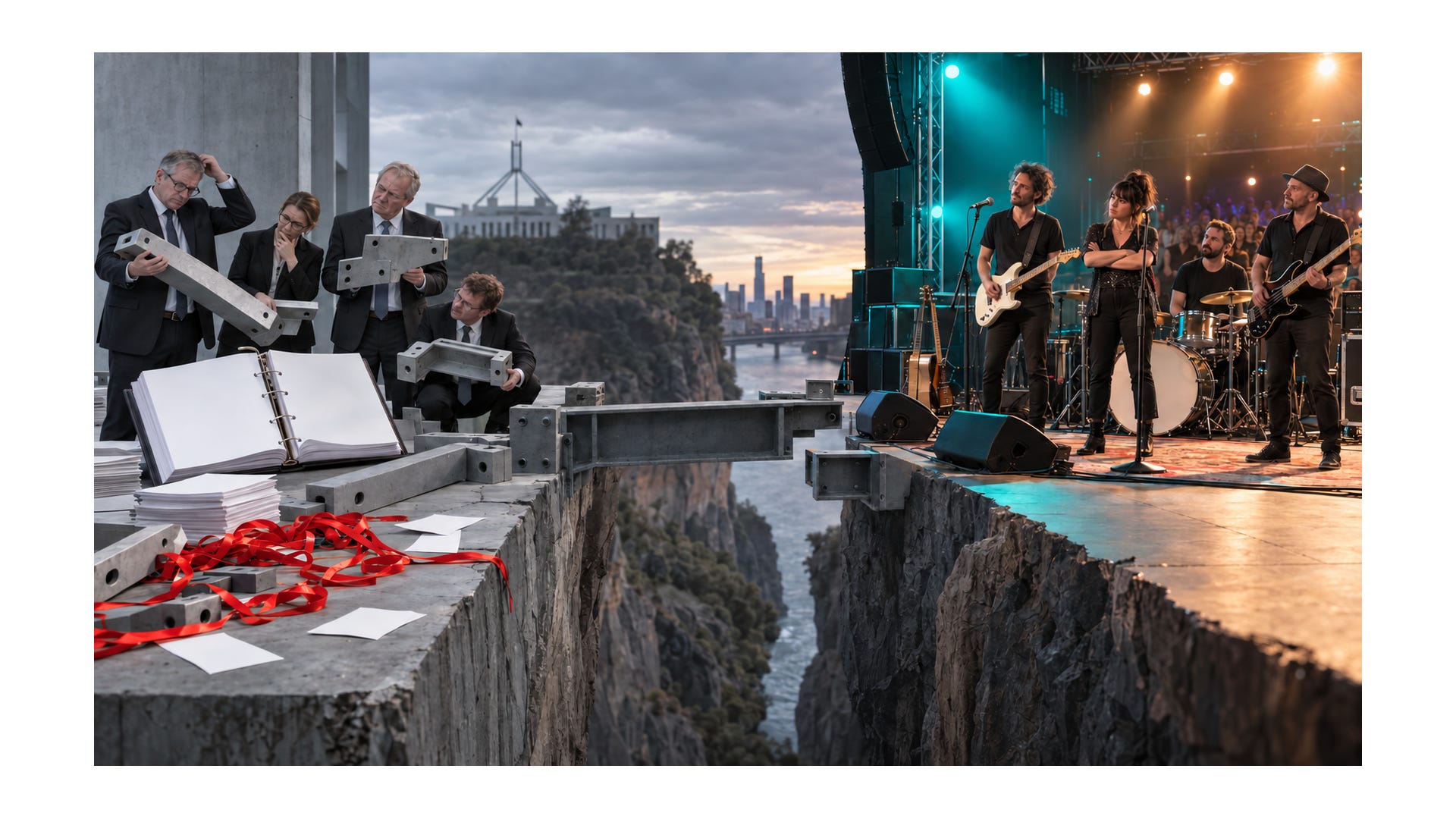
I mean, wouldn’t it be great if they were able to explain the policy foundations of section 12(8), disclose the consultation and evidence behind it, address its interaction with state agency legislation, provide workable rules for bandleaders and subcontracted musicians, establish credible apportionment standards, recognise the composite commercial nature of a live show and model the effect on purchasing behaviour, and review the law if its assumptions no longer fit the market?
And while we chuckle uneasily to ourselves muttering, “And pigs might fly,” perhaps the best thing for all music industry practitioners to do, is get back to business, obtain accounting and legal advice to clarify their own business structures, separate labor and non-labor costs properly, and continue to build the value of their music brands and show offers to reflect their value in this market.
Because, while this industry has inherited a retrofit of 1992 legislation into a commercial market that it simply does not fit, it should not necessarily follow that this market should dissolve into a civil war between musicians, venues, festivals, and agents.
Just because the government failed to get its act together doesn’t mean we shouldn’t.
Nichola Burton is the co-founder and CEO of The Pushworth Group, an Australian live-music agency established in 1991. After 35 years negotiating and administering performance contracts between artists and venues, she writes from inside the machinery of the industry—where legislation, commercial reality, and common sense do not always share the same stage.
