

The Australian music industry has spent decades talking about women’s safety. Perhaps it is time we talked about power — and stopped confusing business relationships with protection.
When we started our agency in 1991, a high profile agent in Sydney rang the office and violently tore strips off me. It was brutal. I had never worked with him. I barely knew who he was. And it turned out to be a case of mistaken identity. He never apologised. The truth wasn’t particularly important to him. The power play was. I remained polite and professional throughout the call because that was what women were taught to do. Don’t antagonise him. Don’t make it worse. Keep your composure.
Unfortunately, to a serial bully, politeness can look remarkably like permission.
Years later, a young inexperienced Queensland agent tried the same routine. I listened to him rant for a while and then asked him whether he needed a hug. What followed was a volcanic eruption of language that would have made a wharfie blush. Again, the issue had nothing to do with me. It was theatre. Intimidation dressed up as authority. A few years later, he went bankrupt and disappeared from the market. Karma.
I believe that the Australian music industry has a problem.
The 2022 Raising Their Voices review put numbers around something many of us had been witnessing for decades. Nearly 80% of survey participants reported experiencing some form of bullying during their careers. More than half reported experiencing sexual harassment or sexual harm. Only a tiny proportion formally reported what happened.
That isn’t because Australian women suddenly forgot how to speak. It tells us something about the environments in which they were working.
Music has traditionally operated through extraordinary concentrations of power. One person controls the booking. Another controls the recording. Someone controls the tour. Someone else controls access to the artist. One central source controls the publicity. Another controls the money. A long line of someone’s controlling whether the phone rings again.
And when your income, opportunity and reputation depend upon a relatively small group of gatekeepers, saying no will of course be an economic decision.
I know what this looks like first hand. When I recorded my second album, I worked with a producer I won’t name. His methodology was very old school. First came the seedy, suggestive language. I ignored it. Then came the subtle bullying evolving into full scale narcissistic abuse. At the time, I didn’t have the language or the resources to understand the dynamic. I knew something was wrong, but I didn’t understand the mechanism. So I endured it. Like countless women before and after me, I got hooked into someone else’s power play. But I never forgot.
And over the years, female artists have shared their versions of that story again and again. Different faces. Different names. Same script. All playing out in dressing rooms, studios, offices, green rooms, flights, taxi’s and hotel rooms across the country.
The recent revelation about one of Australia’s high profile Agents and Managers should make every woman in this industry reconsider their business plans. Found guilty of two counts of rape and one count of sexual assault against a former employee and subsequently sentenced to six years’ imprisonment, this former influential entertainment manager, whose roster included many of Australia’s most successful artists, is poised to become one of our industry’s greatest cautionary tales. He is not the whole story. He is the part of the iceberg we can now see.
Because somewhere in Australia right now, there will be a woman reading about a convicted man and simultaneously talking herself out of recognising what is happening in her own professional life. “My boss isn’t like that.” “He’s just difficult.” “That’s just how this industry works.” “I need the gig.” “I don’t want to cause trouble.” “Maybe I misunderstood.”
“It’s not that bad.”
That last sentence alone has protected an extraordinary amount of bad behaviour.
Abuse of power rarely introduces itself with a business card. It can be the manager who humiliates you in front of everyone. The producer whose sexual jokes become hostility when you don’t respond. The promoter who suddenly stops booking you after you reject an advance. The executive who controls access, information and opportunity. The person who alternates praise and punishment until you start managing their emotional state instead of your own career. The person who convinces you that without them, you’re finished.
And because the behaviour often sits below the threshold of something obviously criminal, women minimise it. Until eventually they don’t know where the professional relationship ends and the psychological one begins.
In 2022, a young female musician that we worked with at the time, publicly spoke about her experiences as a young performer, including feeling pressured to have sex with venue managers or risk not being booked again.
The transaction for so many Artists like her is less about sex and more about power. Someone controlled access to income and attached another condition to it. And when a young artist speaks publicly about an experience like that, we tend to focus on her bravery. But what about what we are asking her to carry? She has to reopen the experience again and again. She has to tell strangers, feel wrongly placed shame, anticipate disbelief and has to wonder what future employers, venues and promoters will think. She has to expose herself professionally in order to warn the next woman.
Me too.
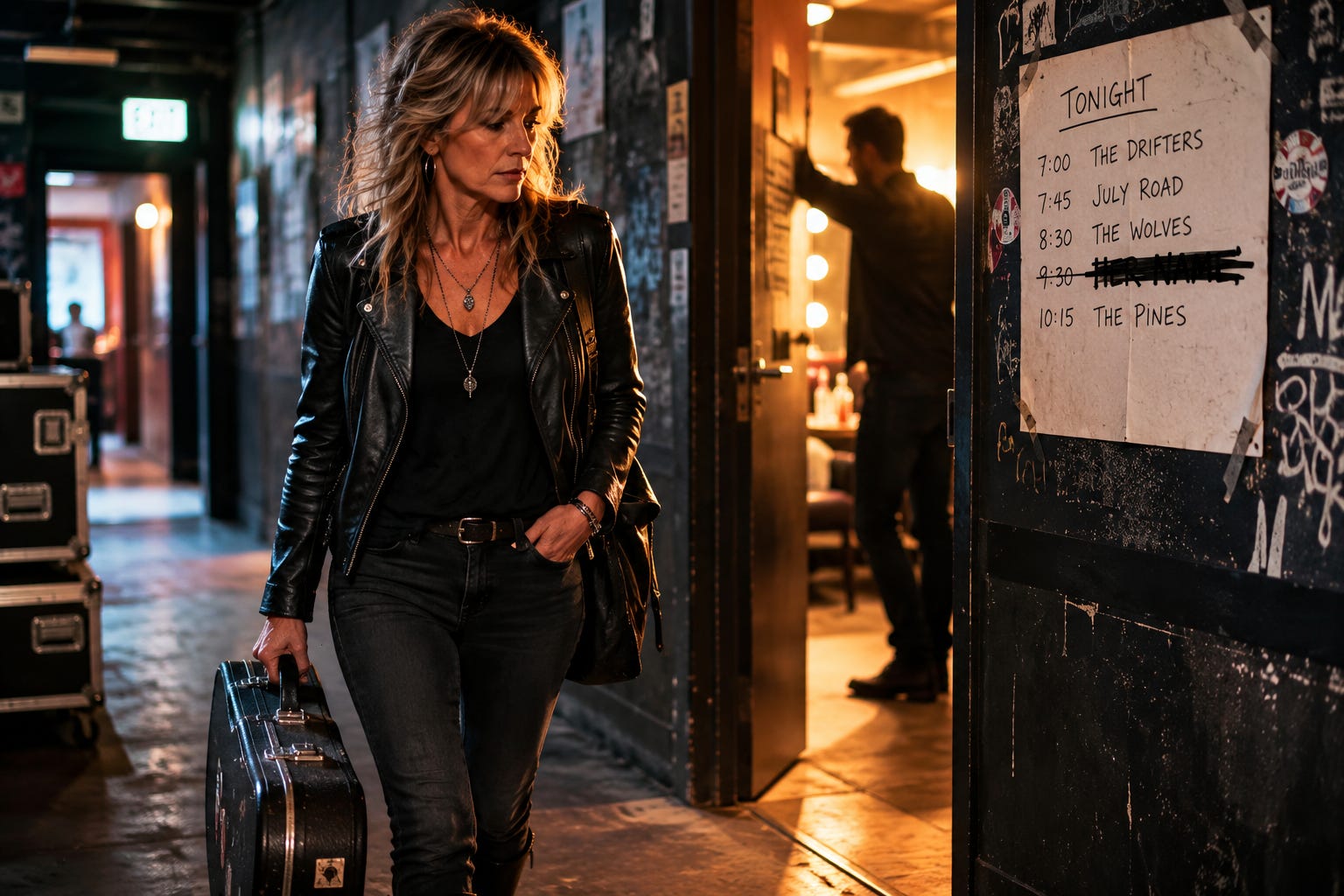
As a young performing artist, I endured years of sexual harassment. Venue managers. Duty managers. Bar staff. Security. Punters. Back then, it was treated as part of the job. My male bandmates would sometimes tell me: “Just be careful how you say no. We don’t want to lose the gig because of you.”
Read that again. Not:” Are you okay?” Not: “We’ll deal with him.” But: “Don’t cost us the gig.”
So I got creative. I learned to read rooms. Avoidance. Distracting humour. I learned how to reject someone without humiliating them. Where to stand. Who to stay near. When to leave. How much friendliness was safe. How much firmness might cost us money. Women of my generation became extraordinarily good at this. We called it professionalism but in truth it was actually threat management.
When I started the agency, I had one goal. Music Means Business. It was never just a marketing line. I wanted the business to create healthier boundaries. Business asks: “What is the agreement? What are the deliverables? What is the fee? Who has authority? Who owns what? What happens when something goes wrong? Where is it documented? What is the professional relationship between these people?”
Why? Because ambiguity is where manipulators thrive.
Take the conversation out of the hotel room and put it into the contract. Take it out of the late-night drinking session and put it into an email. Take it out of trust me and put it into agreed deliverables. Take it out of personality and instead measure performance against business metrics. And for God’s sake, stop believing that access to someone powerful requires access to you.
Your body is not part of the deal. Your emotional compliance is not part of the deal. Your silence is not part of the deal.
If you watched the recent interview with Tina Arena and Kate Miller Heidke, like me, you may have noticed something critical that Tina said. “Make sure you’re safe with the people around you.”
100%. But I think we need to go one step further.
Artists routinely parentify the people around them. Managers. Agents. Publicists. Tour managers. Producers. Crew. Someone becomes the protector. Someone becomes the fixer. Someone becomes Mum. Someone becomes Dad. Someone knows everything. Someone handles everything. Someone makes the scary decisions. And slowly, a commercial relationship becomes something else.
That is quite the slippery slope.
Your manager is not your parent. Your agent is not your parent. Your publicist is not your parent. Your producer is certainly not your parent. These are professionals providing services within a business relationship. If you feel the need to shower them with praise. Don’t. Simply be professional and pay your invoice. If you feel the need to unload your emotional day. Don’t. Take a breath and call your therapist.
Because when Tina speaks about safety, this includes you. Get to know who YOU are. Your triggers. Your boundaries. And everything in between. You cannot outsource this job. It’s on you and you alone.
Recognise what happens to you when someone intimidates you. Do you freeze? Appease? Become excessively polite? Try to make them like you? Avoid conflict? Hand over decision-making? Second-guess yourself? Stay because leaving feels more frightening? Flirt to distract? Those responses aren’t business strategies. They’re triggers. Know yours.
Build your professional systems around them. Have people outside the commercial relationship whom you trust. Have your own advisers. Understand your contracts. Understand your money. Keep your own records. Maintain your own relationships. Protect your independence.
And build a self-care practice strong enough that somebody else’s emotional volatility doesn’t become the weather system governing your career.
The cold hard fact here is that live music contains an inherent commercial imbalance. Artists need places to perform. Venues take financial risks putting entertainment into their rooms. Promoters control opportunities. Managers and agents can influence access to markets. Record companies invest capital. Those relationships will always contain different forms of leverage. Leverage itself isn’t abuse. And it needs to be said clearly that in my experience, the overwhelming majority of venue managers, promoters and music professionals we work with conduct themselves professionally.
This is not an indictment of men. It isn’t an indictment of venues. And it isn’t an indictment of the entire Australian music industry. It is an indictment of people who exploit power when they discover they have it.
Because it only takes one. One producer. One manager. One promoter. One record executive. One agent. One venue manager. One person who discovers that another person’s livelihood gives them leverage — and decides to use it.
Legislation matters. Reporting mechanisms matter. Codes of conduct matter. Accountability matters. But none of those things will magically remove narcissism, entitlement, predatory behaviour or plain old-fashioned bullying from human beings.
Which means women need something else as well. Agency. Not the music-business kind. Your own. Tina Arena expressed it beautifully: “We can no longer be seduced by the fantasy of show business, because we will be fucked by the reality of it.”
There it is.
The Australian music industry doesn’t need women to become harder. It needs women to become clearer. Know your business. Know your money. Know your contract. Know your boundaries. Know your triggers. Know who has access to you and why. And never mistake someone’s ability to open a door for ownership of what happens once you walk through it.
Make sure you’re safe with the people around you. And make damn sure one of those people is you.
Nichola Burton has spent more than three decades inside the Australian live music industry as an artist, agent and business owner. She has seen what happens when power, access and livelihoods collide — and what women learn to tolerate when saying no might cost them the gig. She writes about the industry from the place she knows best: inside it, with the receipts.
