

There are two questions Sole Trader musicians have been asking more than any other since 1 July.
“Why isn’t my super 12% of my fee?”
Closely followed by... “Can I just charge it on top?”
The short answer? Yes.
The longer answer is where everyone seems to disappear down an accounting rabbit hole.
Before 1 July, life was pretty simple. The venue had an entertainment budget. The agent rang you. “We’ve got $800 for Saturday night.”
You had three choices. “Yep.” “Nope.” or “Make it $900.”
If everyone agreed, you turned up, played the gig, invoiced under your ABN and, as every agency contract terms and conditions reminded you, you were responsible for your own tax and your own super.
That commercial negotiation hasn’t changed. Venues still have budgets. Bookers still negotiate. Artists still decide what they’re prepared to work for. The only new kid in the green room is Superannuation Guarantee. And every venue is handling it differently.
Some are paying it on top. Some are asking for it to come within the entertainment budget they’ve already allocated. Neither is right. Neither is wrong. It’s simply how that venue has chosen to structure its entertainment spend. As it always has.
So what If your contract is $800, why isn’t your super $96? Because that’s not how the maths works. If the total contract value is $800, the earnings have to be separated from the super first. Like this. Contract Total: $800 First, remove the super component. $800 ÷ 1.12 = $714.29 Now calculate the super. 12% of $714.29 = $85.71
So the breakdown becomes:
🎤 Performance Earnings: $714.29
🎸 Superannuation: $85.71
💰 Total Contract: $800
The super is 12% of your earnings, not 12% of the final amount after the super has already been included.
As the supplier of the service that you contract with each venue, you absolutely are free to quote whatever your performance is worth. When a Booker extends a Gig Offer, you accept or negotiate. The venue then decides whether your offer fits inside their entertainment budget. Exactly the same way they’ve always decided whether your fee fits inside their entertainment budget.
Nothing magical happened on 1 July that suddenly made every venue’s entertainment budget bigger. Some venues have increased their budgets. Some haven’t. Some simply can’t. That’s commercial reality.
Your fee has never been determined by an accountant. It’s determined by the result that the venue is seeking and the value you bring. Can you fill a room? Keep people there longer? Sell more meals? Sell more drinks? Create the kind of night that has patrons booking tables for next month?
That’s your value. That’s your brand. And that’s what venues are buying.
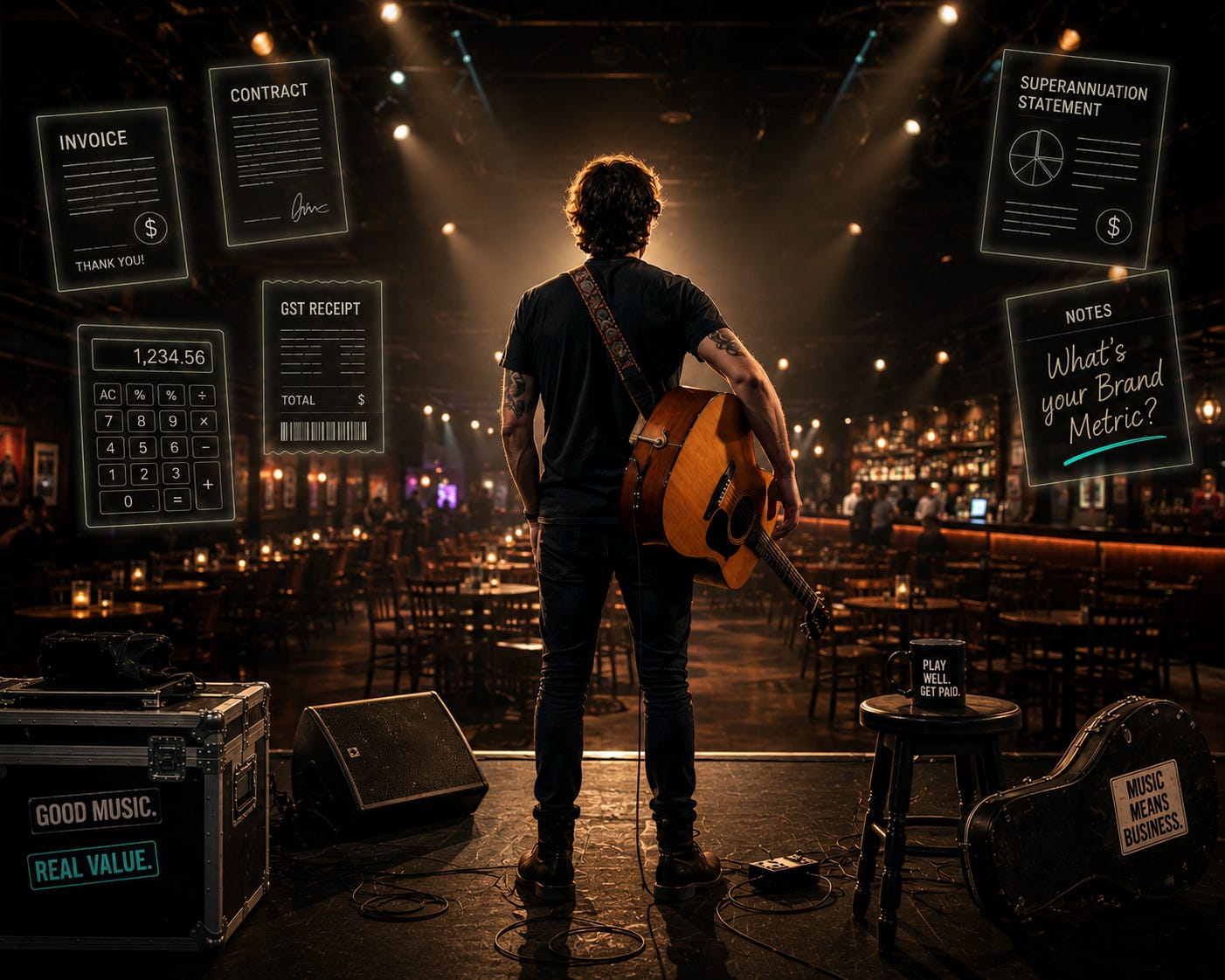
The paperwork may have changed to now show the SG. But the negotiation hasn’t.
Know what you’re worth. Quote accordingly. And then go and play a cracking show. Because audiences still go out to pubs to hear great music.
Superannuation hasn’t changed your value as a performer. It hasn’t made your music worth more or less. What determines your fee is exactly what has always determined it: the quality of your show, the strength of your reputation, the audience you attract and the experience you create for the venue and its patrons.
Know your number. Quote with confidence. If you want Superannuation paid on top of your performance fee, ask for it. If a venue has a fixed entertainment budget, you’ll need to decide whether the offer works for your business. Every booking is still a commercial negotiation between two businesses.
The legislation may have changed. The fundamentals haven’t. Your music is your product. Your performance is your brand. Your fee is simply the price the market is prepared to pay for the value you bring to the stage.
Nichola Burton is the CEO and co-founder of The Pushworth Group, one of Australia's longest-established live entertainment agencies. For more than three decades she has worked at the intersection of artists, venues and the business of live music. Through Musoverse, she unpacks the contracts, legislation and industry changes that affect working musicians, translating complexity into plain English so artists can make informed business decisions and focus on what they do best—creating great live music. Copyright 2026 All Rights Reserved.
