
Let’s begin with the numbers — because culture without economics is fantasy. In 2023–24, the Australian live music industry generated $4.83 billion in revenue. It delivered $1.44 billion in direct Gross Value Added to the national economy. 12 million people attended contemporary live music events — the highest attendance in fifteen years. Live performance accounted for 48% of the $860 million earned by Australian artists. Venues generated $1.8 billion, with $1.31 billion in food and beverage alone. (1)
This is not fringe activity. This is not subsidised sentiment. This is infrastructure. And the backbone of that infrastructure is not stadium tours. It is the working musicians — the sound-tracking operators — activating rooms across the country every week.
The Identity Problem We Don’t Talk About
On stage, we celebrate autonomy. We celebrate voice. Presence. Authority. Creative command.
Off stage, there are some who too often structure musicians as if they are rostered labour.
There is a distinct contradiction there.
Because the same person who reads a room, shifts a set list, extends a chorus, adjusts energy in real time — that person is not executing a script. They are exercising judgement. That judgement is entrepreneurial. A working musician:
Invests in equipment
Maintains insurance
Manages GST
Issues invoices
Negotiates rates
Absorbs cancellation risk
Builds brand equity
Performs for multiple venues
That is enterprise behaviour.
If we culturally frame that person as dependent labour rather than an operator within a supply chain, we create psychological stress. And stress is a performance killer.
A Show Is Not a Shift
Operators think in seasons. Labour Hire thinks in shifts. If a musician sees their work as enterprise, they protect reputation, invest in growth, refine positioning, build market fit. If they see their work as shift-based, delivery becomes transactional.
In a $4.83 billion ecosystem, that distinction matters. Because hospitality revenue is not driven by background noise. It is driven by engagement. Engagement comes from ownership. Ownership is psychological before it is contractual.
The Infrastructure Gap
Here is the uncomfortable truth: The global live music market does not suffer from a talent shortage. It suffers from a systems shortage. Too many working musicians are running viable micro-enterprises out of:
Email threads
Text messages
Memory
Scattered calendars
And late-night reconciliation of invoices
That is not sustainable enterprise. That is hustle without infrastructure. And hustle alone does not stabilise an industry.
This Is where some Marketplaces position themselves
Marketplaces with Booking Apps are not here to diminish autonomy. They exist to reinforce it. Not as a gatekeeper. Not as a controller. As infrastructure for independent enterprise.
Live Booking Apps are designed to:
Centralise gig management
Formalise contracts
Enforce cancellation clarity
Track payments transparently
Verify administrative integrity
Maintain professional promo presentation
Not to control artists or suppliers rather to greater support all operators - promoters and artists. Because when structure is present:
Cognitive load reduces
Payment friction decreases
Contractual ambiguity disappears
Reputation becomes measurable
And when that weight lifts, performance improves. Autonomy on stage is strengthened by stability off it.
The Classification Conversation
This is not an argument against employment where employment is appropriate.
Orchestras. Musicals. Productions. Long-term salaried positions. Defined roles.
Those are legitimate structures.
But where musicians:
Operate across multiple venues
Supply their own production
Invoice independently
Bear commercial risk
Then structure should reflect supplier status. Correct classification is not ideology. It is accuracy. Misalignment weakens identity. Alignment strengthens ecosystems.
Why This Matters for the Future
The Australian live music economy is growing. International activity contributed approximately $975 million. The broader live performance industry reached $3.4 billion in ticket revenue in 2024, up 6.9% from the previous year. (2) This is a mature sector.
Mature sectors require:
Clear systems
Professional standards
Transparent transactions
Enterprise recognition
If we want sustainability, we must stop oscillating between two extremes:
Romanticising artists. Or reducing them to labour inputs. Working musicians are neither. They are small business operators inside a commercial cultural economy.
The Alignment We Need
Autonomy on stage. Infrastructure off it. That alignment does three things:
Strengthens psychological authority.
Increases commercial discipline.
Stabilises economic contribution.
Pushworth’s broader positioning is simple: Support independent music enterprise. Build systems that make professionalism easier. Encourage clarity over chaos. Reward delivery over mythology.
Because when musicians operate as recognised enterprises, they:
Negotiate with confidence
Perform with authority
Invest with intention
Build with longevity
And that strengthens every venue, every audience, and every dollar inside the $4.83 billion ecosystem.
Final Thought
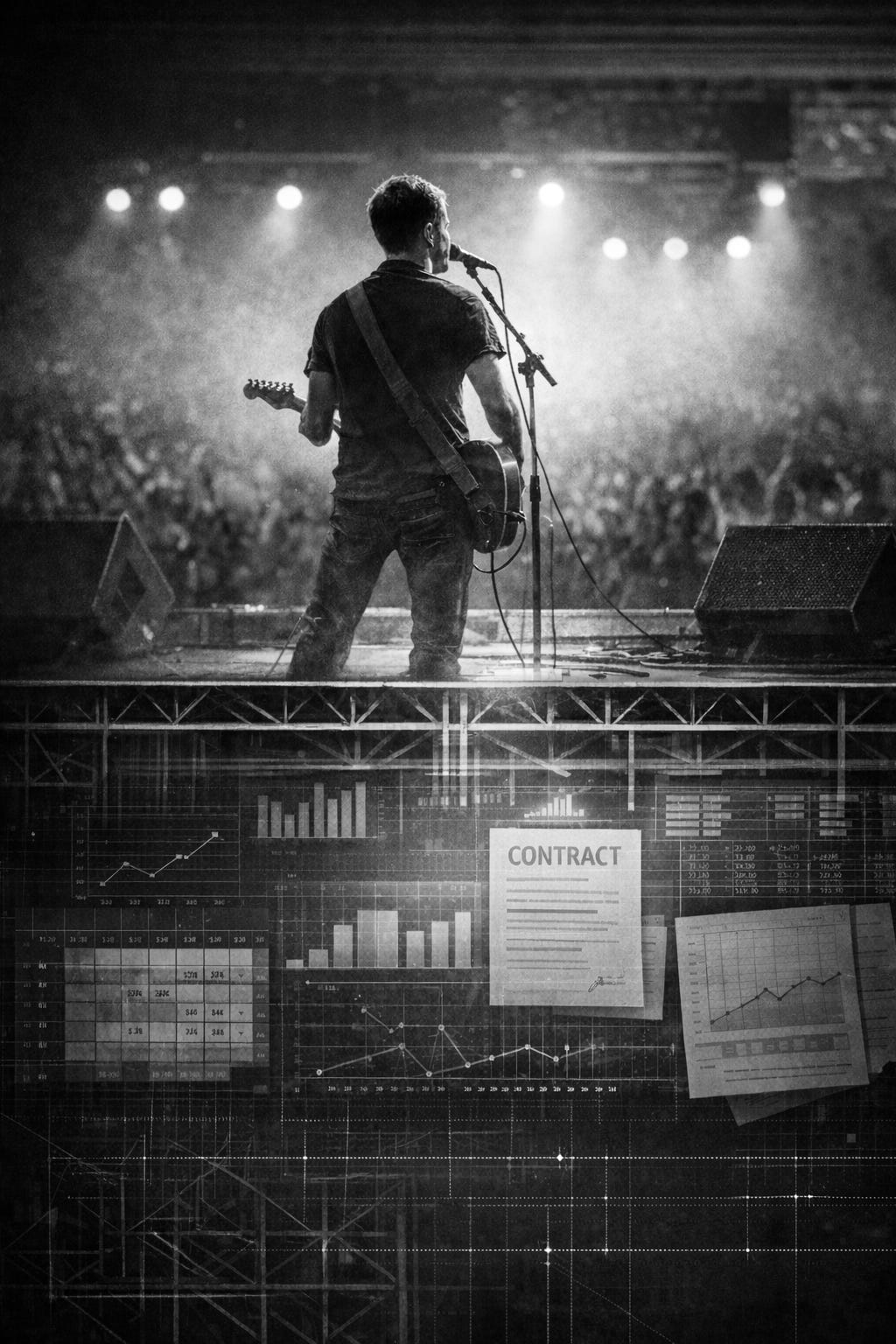
The stage is where culture becomes visible. Infrastructure is where culture becomes sustainable. If we want the Australian live music sector to continue growing — commercially and culturally — we must align identity with structure.
Celebrate the autonomy.
Build the scaffolding.
And recognise the working musician for what they are: An independent operator powering one of the nation’s most dynamic industries.
That is not rhetoric. That is economic fact.
(1-2) Creative Australia (2025). The Bass Line: Charting the Economic Contribution of Australia’s Music Industry. Reporting on the 2023–24 financial year.
Written by Nichola Burton. I work in partnership with Agents, Artist Managers and Event Producers, who juggle a diverse range of relationships in the Musoverse, to curate, manage and measure data in systems, experience, creative and content to support the entire Musoverse operation in my enterprise A Little Pitchy Copyright 2026