

Australians still like live entertainment. Creative Australia’s latest participation research found 74% of Australians attended a live arts event or festival in 2025 — around 15.4 million people. Live Performance Australia recorded 31.45 million attendances and $3.35 billion in ticket revenue in 2024.
So no. Everyone hasn’t suddenly decided to stay home. What has changed is when they’re prepared to hand over the money. And if you’re selling tickets, that’s now your problem to solve.
Creative Australia found 60% of Australians say ticket or entry cost is a barrier, and 55% missed something they actually wanted to attend because of cost. This isn’t necessarily a demand problem. It’s a conversion problem.
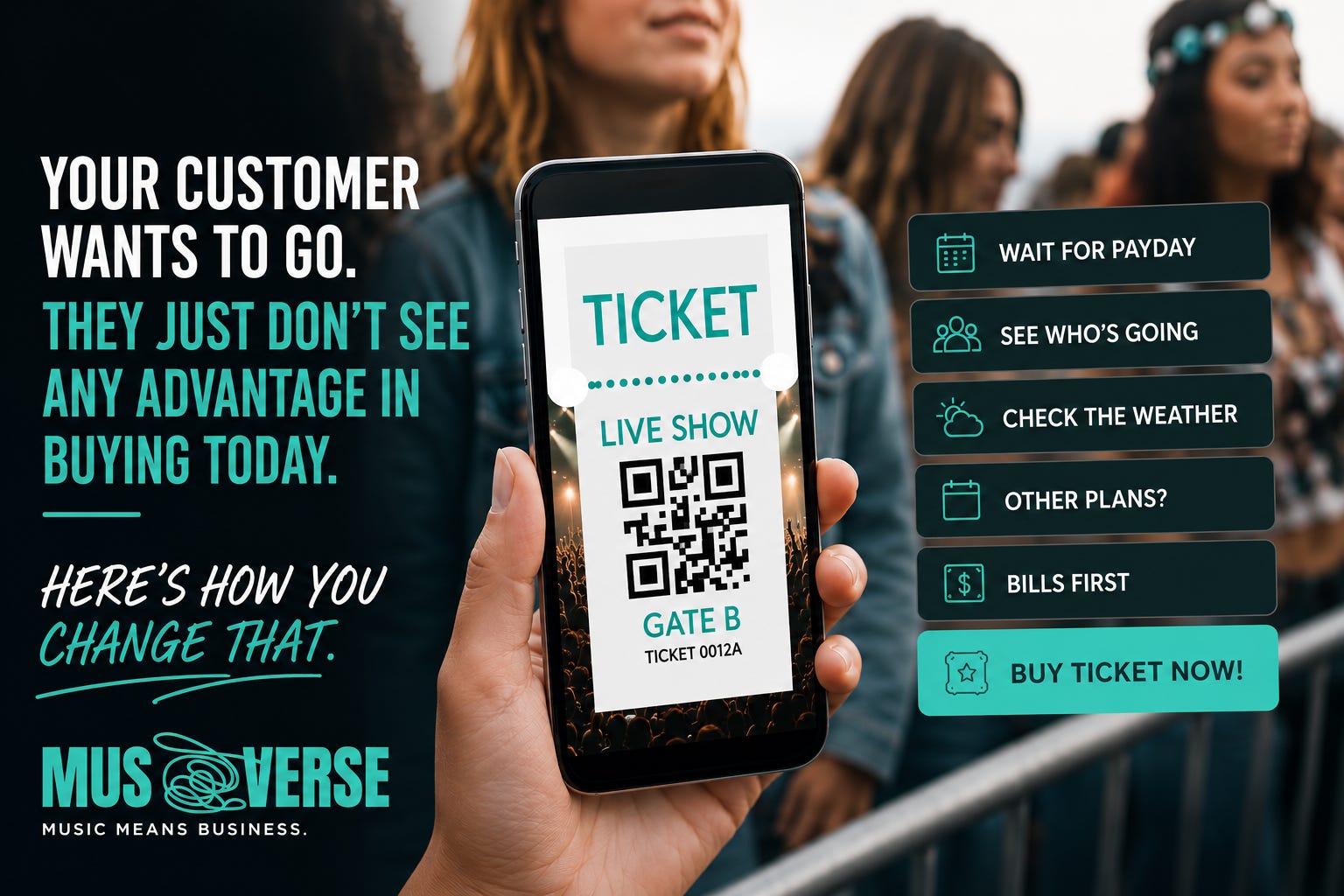
When money feels tight, buying a ticket six weeks ahead means giving up cash for something you don’t need today. Why do that if you can wait? Wait until payday. Wait until the mortgage comes out. Wait to see who else is going. Wait to check the weather. Wait until you’ve paid the electricity bill and discovered whether the car needs four new tyres.
And remember, your “$45 ticket” isn’t necessarily a $45 decision. Two tickets. Booking fees. Dinner. Drinks. Uber. Babysitter. There’s your $200 night. So they wait to buy their tickets. Kinda makes sense.
The challenge here is that we have an entire industry model expecting the audience to behave differently but without giving them a reason to. Three weeks out with bugger-all presales, repeatedly posting the same show tile with: DON’T MISS THIS AMAZING SHOW!, is not a marketing strategy. Neither is blaming the economy.
Audiences have limited discretionary money and a ridiculous number of things competing for it. And your business is based around encouraging them to buy YOUR ticket above everything else.
So number one, let’s look at the offer.
Nobody needs a four-piece band. Or a tribute show. Two hours of comedy. An orchestra. People are buying a visceral feeling in their bodies, hearts and minds. They are buying an experience.
This is why nostalgia is so commercially powerful. Fleetwood Mac isn’t simply a catalogue of songs. It’s being 25 again. It’s your sister. Your first boyfriend. The road trip. The divorce. The song you screamed into a hairbrush in 1987. It’s your best mate holding your hair back while you call god on that big white phone as Rhiannon plays in the background.
The product that you are selling tickets for, is the memory. So stop leading with: “Queensland’s premier seven-piece tribute featuring some of Australia’s finest musicians.” Nobody outside the band meeting cares. Tell me what kind of night out I’m buying.
Can you answer this next question, number two, “Why should I buy NOW?”
We put a show on sale eight weeks out. Same ticket price today. Same ticket price next month. Same seat. Plenty of capacity. Definitely tickets at the door. Then we’re mystified that people wait.
Of course they wait.
If you want early commitment, give early buyers something worth committing for. Best seats. Reserved tables. Priority entry. Dinner package. Drink inclusion. Merch. Limited allocation. Not necessarily a discount. In fact, be careful with discounts. If you routinely panic three days out and start flogging two-for-ones, congratulations. You’ve successfully taught your customer: Never buy early. These people crack eventually.
Number three consideration is where is the FOMO element in your campaign strategy? Creative Australia’s live-music research found 72% of engaged audiences saved money specifically to attend major live-music events.
Same economy. Same grocery prices. Same mortgages. But suddenly they found the money. Why? Because missing that particular experience mattered more.
That’s the psychology you need to create.
One night only. Only Brisbane show. Final 30 tickets. Limited tables. Special guest. Something that genuinely makes waiting risky. But it needs to be true. A SELLING FAST 🔥🔥🔥 graphic when you’ve shifted 42 tickets just makes everyone look ridiculous.
If you want people to buy tickets, change the offer. “A band playing Saturday night” is something I might check out if I have nothing better to do. “One Night of the Greatest Australian Anthems of the 80s” sounds like something I organise my mates for.
Same room. Possibly some of the same musicians. Definitely many of the same songs. Completely different offer. The key is to psychologically frame your offer as an EVENT instead of a GIG.
Australia has spent decades teaching pub and club audiences that live music is free. Turn up. Band’s playing. Buy a beer. A half decent Parmy. A little flutter on the pokies. Game of pool. Catch up with your mates.
Isn’t it insane that we put a ticket link in front of the same customer, and expect them to behave like a Broadway subscriber, when the offer, marketing and psychological approach is exactly the same?
The Australian audience hasn’t gone tits up. They’re just being choosier about where their money goes. Stop asking: Why aren’t people buying tickets? Instead ask: Why would someone buy THIS ticket TODAY?
If you can’t answer that in one sentence, don’t blame the punter. Fix the offer. Because your customer doesn’t owe the live music industry their support. They don’t have to buy a ticket because Artists need work, venues are struggling, production costs have increased or we’d all really like them to keep music live.
They’re customers.
Give them something they want badly enough to pay for.
Then give them a reason not to wait.
Statistics referenced in this article are drawn from Creative Australia’s 2025 National Arts Participation Survey and live-music audience research, and Live Performance Australia’s 2024 Ticket Attendance and Revenue Report. The broader analysis is drawn from the 2026 white paper, The Psychology of Ticket-Buying in Australian Live Entertainment, by Nichola Burton, A Little Pitchy.
References & Sources
1. Creative Australia — Creative Transformations: National Arts Participation Survey 2025
Creative Australia, 2026.
Nationally representative research involving 9,065 Australians aged 15+. Key findings cited include:
74% of Australians attended a live arts event or festival in 2025.
Approximately 15.4 million Australians attended.
Attendance was the highest recorded since the survey began in 2009.
60% cited ticket or entry cost as a barrier.
55% missed an arts event they wanted to attend because of cost.
Creative Australia — Creative Transformations
2. Creative Australia — Strong audience demand for live music lives on despite cost-of-living pressures
Creative Australia. Research into Australian live-music participation, motivations and barriers. Statistics cited include:
92% of music-engaged Australians say live music has a big or very big impact on their wellbeing and happiness.
72% saved money to attend one or more major live-music events.
Cost remains the primary barrier to attendance.
FOMO is an important purchasing driver, particularly for major and international artists.
Audiences are increasingly purchasing tickets closer to the event.
Creative Australia — Live Music Audience Research
3. Live Performance Australia — Ticket Attendance and Revenue Report 2024
Live Performance Australia, 2025. National ticketing and attendance data cited include:
31.45 million total live-performance attendances.
$3.354 billion total ticket revenue.
$115.12 average paid ticket price.
Contemporary music generated approximately $1.811 billion.
Contemporary music attracted approximately 14.08 million attendances.
Contemporary music represented 54% of industry revenue and approximately 44.8% of attendance.
Live Performance Australia — Ticket Attendance and Revenue Report 2024
4. Creative Australia — Soundcheck: Insights into Australia’s Music Festival Sector
Creative Australia, 2024. Used particularly in examining younger consumers and late purchasing behaviour. The research identified younger audiences as particularly likely to make last-minute ticket purchases and examined affordability, changing consumer behaviour and festival attendance.
Creative Australia — Soundcheck research
5. Creative Australia — Listening In: Australia’s Live Music Audiences
Creative Australia. Research into where Australians experience live music and changes in attendance behaviour, including the distinction between major venues/events and live music presented in pubs and clubs.
Creative Australia — Listening research series
6. Roy Morgan — ANZ-Roy Morgan Consumer Confidence, 25 August 2026
Used for the discussion of Australian household financial confidence and the economic environment surrounding discretionary purchasing.
Figures cited include:
Consumer Confidence of 77.5 in late August 2026.
Confidence remained 8.5 points below the comparable period a year earlier.
17% of Australians said their families were financially better off than a year earlier.
49% said they were worse off.
21% expected their family to be financially better off in a year’s time.
37% expected to be worse off.
Roy Morgan — Consumer Confidence, August 2026
7. Roy Morgan — Inflation Expectations / Consumer Confidence Update, August 2026
Used for the reference to Australian inflation expectations reaching approximately 6.1% in late August 2026.
Roy Morgan — August 2026 update
8. A Little Pitchy — The Psychology of Ticket-Buying in Australian Live Entertainment Nichola Burton, 2026. White paper commissioned by A Little Pitchy for the Musoverse. Download Here
The white paper synthesises Australian live-performance participation, ticketing, household spending, consumer confidence and international audience research to examine:
advance purchase versus walk-up behaviour;
financial optionality;
FOMO and scarcity;
price sensitivity;
total experience cost;
audience segmentation;
destination-venue behaviour;
the shortening commitment horizon;
and implications for venues, promoters, agents and Artists.
Research note: Statistics in this article are drawn from the sources above. Observations about financial optionality, familiarity reducing purchase risk, destination venues, eventisation, scarcity and the distinction between demand and commitment are the author’s analysis of those findings and more than three decades working within the Australian live entertainment market. Australia does not currently publish comprehensive national data showing exact ticket-purchase lead times across every live-performance sector, so no such figures have been inferred or invented.
Nichola Burton is a Strategic Brand Architect and Co-Founder of The Pushworth Group, with 35 years inside Australia’s live entertainment market. She works at the intersection of audience behaviour, entertainment, hospitality and business strategy — looking past what the industry wants to sell to understand what customers actually want to buy. Through Musoverse, she writes about the business behind the music, because great entertainment is only half the job. The other half is getting someone to pay for it.
